

Consumer shopping habits are not fixed: they change over time according to product availability, convenience and whether or not the product is relevant or affordable. Consumer purchasing patterns are also influenced by peer pressure, social and other forms of media, environmental concerns or by fresher-looking competitive rival products. All of these reasons may drive customers away. Many brand owners, purchasing pattern forecasters and marketing personnel must feel they are chasing a constantly shifting target as products come in and out of fashion.
Food, beverages and manufacturers of consumer goods are also driven by business conditions, which may be global in context and which often require an assertive and dynamic approach to every aspect of marketing, including presentation. Brands have to set up their pitch in the market that they serve and be strong, clever and adaptable.
Meeting expectations
Brand owners and marketers expect their business partners to become fully engaged from concept through to the completion of the printed and converted labelling, packaging or other project. Short run lengths, fast turnarounds and a willingness on the part of customers to take their business elsewhere if quality doesn’t live up to expectations are just some of the realities that the graphic arts professional has to face up to.
Bearing in mind all of the realities of print, it is necessary to control process variables so that a consistent product, with faithfully produced colour, text and graphics, is output to time.
Assessing label and packaging print quality is not necessarily straightforward; in fact, it can be a difficult task. Much depends on the purpose of the printed product and the customers’ expectations and objectives. Complicating matters is that each and every individual (potential consumer) may perceive product quality in different ways, which, from a process control point of view, can cause complications in terms of real-time feedback control.
Colour defines the brand. Colour, though, can be a slippery customer. Certain colours can produce unexpected results. When flexo printing onto filmic label stock, the light scattering characteristics of an opaque white ink layer can affect the appearance and finish of a product. Colour may sometimes appear more intense than it should be; this may be down to one or more causes. Too much ink may be carried by the metering roll or doctor blade. Alternatively, the problem may be due to the ink becoming too concentrated during mixing.
Real-world consequences of colour deviations
Colour that doesn’t sit right has consequences. Colour, graphics and text are the printed face that the product presents to the world. Packaging formats may change, and the graphics and other value-added components might alter during a marketing refresh or re-launch, but the colour associated with the brand generally remains the one constant.
Colour may agree with set numerical values, but when viewed and the presentation sample approved, it’s not unknown for customers to raise colour-related concerns. Colour and how it appears as eluded to earlier is also influenced by the health, age of the viewer and even culture.
The light under which the sample is examined may appear fine, but some thought must be given to how colour or colours may appear when an item is on the shelf in a retail environment and where the light may be far from perfect.
If we consider the variables we want to control, it is necessary to have an appreciation of the internal and external factors that contribute to forming processing inconsistencies in the first place. Mottling, for instance, is often associated with what is introduced into the process, for example, papers, films, etc. Often, mottling is due to unevenly coated paper or board, which in turn results in excessive substrate absorbency.
Dot gain in itself is worth mentioning. Dot gain can be due to both physical and optical factors. Plate deformation may affect the printed dot and may manifest itself as a lateral expansion of the dot surface due to compression. Dots may also appear barrelled. Too high printing pressure can lead to dot gain, whereas a higher ink viscosity may make for a small dot gain.
Dot gain is one thing; missing dots, also called speckle, is often associated with paper surface roughness and with gravure printing.
The clock is ticking
Working ever aware that the clock is ticking, print and process standardisation is a lofty ambition that many practitioners of label and package converting would aspire too, if that were possible.
It is difficult, and some would say it is impossible, to standardise many of the print and converting processes. For one thing, label and package printing is generally not like a good many manufacturing processes with conveyor flow line systems, where input parameters once set are not touched for long periods. Label printing and converting is different in that, by comparison, job changes are frequent and so too are the materials used, the inks and coatings and the substrates.
Instrumental measurements are based on the ability of the device to accept input pre-defined parameters so as to detect out-of-spec variance. Visual methods are associated with the perceived perception of one or more operators and quality control inspectors. Neither method of evaluating quality should be exclusive, and ideally, both methods in some form or another should be in place.
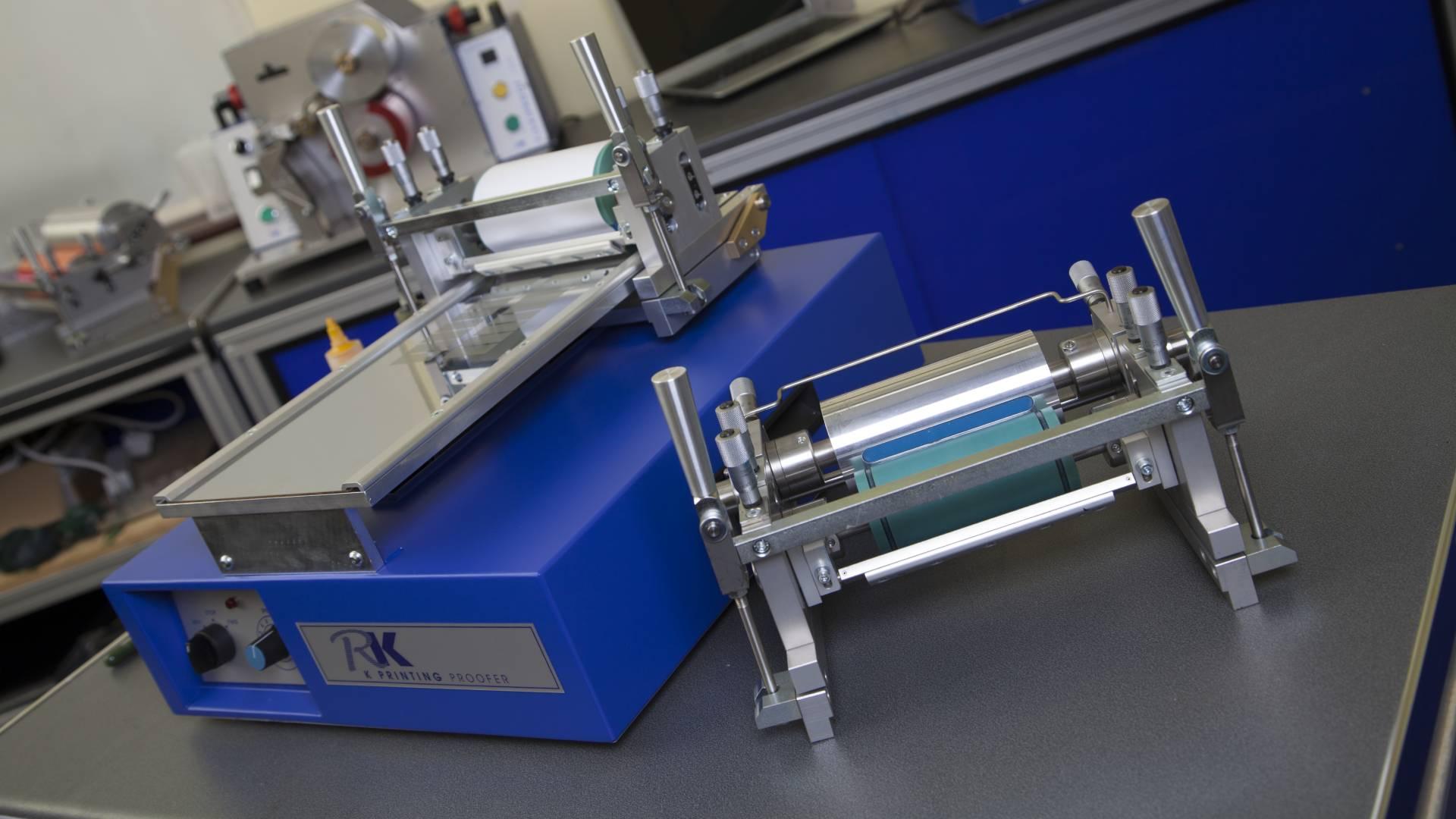
Pre-press colour communication or proofing devices such as the K Printing Proofer or GP100 gravure proofer enable users to meet visual acuity as well as computer colour matching targets accurately and resolve issues surrounding inks, substrates and printability. Pilot coating systems such as the VCML enables users to trial different consumables and substrates and undertake small-scale production.
Written by Tom Kerchiss, Chairman of RK Print Coat Instruments Ltd