

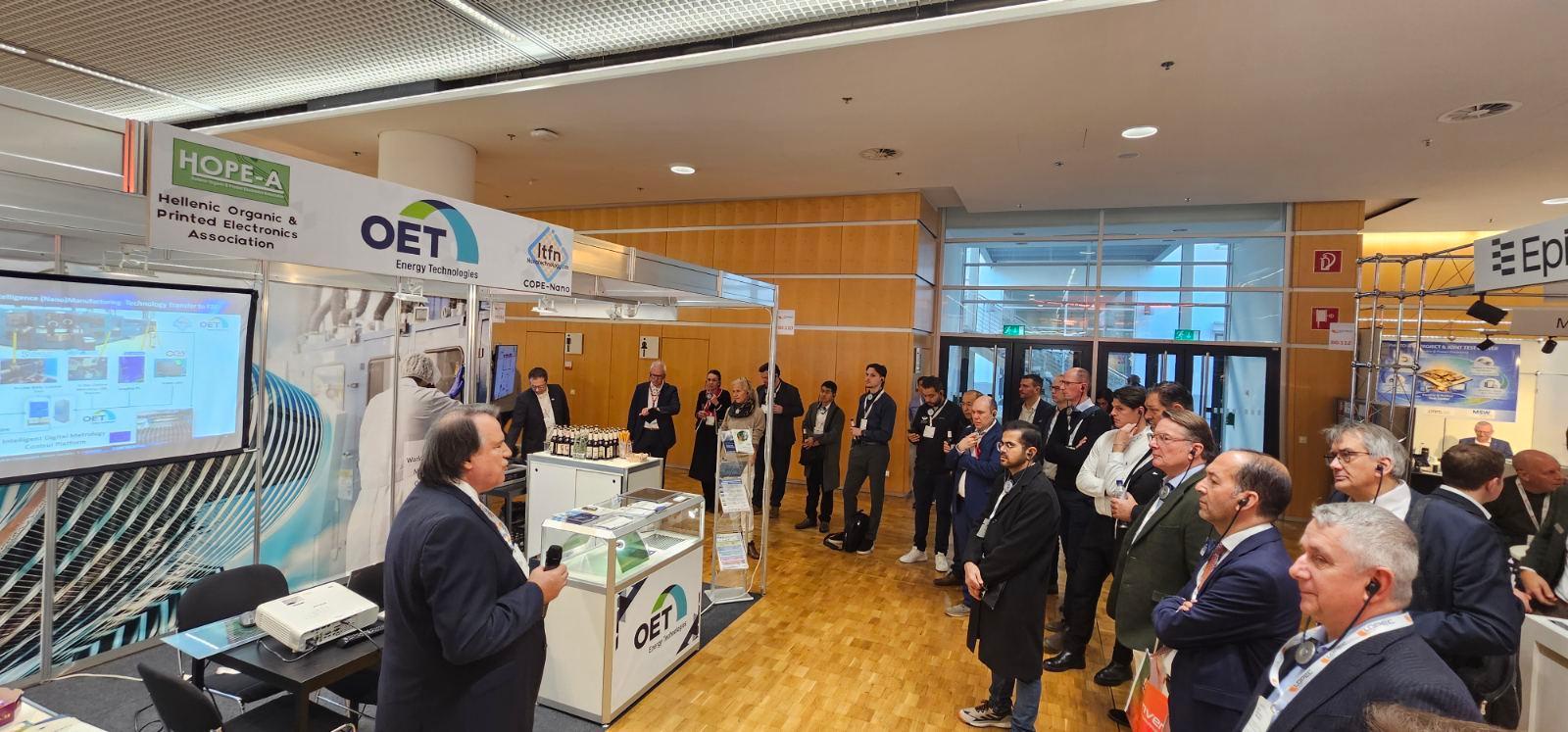
The two European flagship projects Flex2Energy and COPE-Nano Center of Excellence were presented at LOPEC 2026 (24–26 February 2026, Munich), underlining Europe’s – and particularly Greece’s – growing role in green industry and sustainable energy production. LOPEC is regarded as one of the leading international platforms for organic and printed electronics, bringing together stakeholders from research, technology development and industrial manufacturing.
World’s first automated IOPV mass production line
At a central event hosted at the booth of Organic Electronic Technologies (OET), Founder and President Emeritus Professor Stergios Logothetidis introduced what is described as the world’s first fully automated mass production line for Integrated Organic Photovoltaics (IOPVs). The line is currently being established in Thessaloniki, Greece, within the framework of the Flex2Energy project, which unites 14 research and industrial partners from seven European countries.
Flex2Energy (HORIZON-CL5-2022-D3-01) aims to install the first automated large-scale production line worldwide for integrated OPVs. The facility combines advanced roll-to-roll (R2R) printing systems with automated assembly units and in-line quality control based on artificial intelligence in accordance with Industry 4.0 principles. The objective is to enable scalable, cost-efficient production of customised energy-generating surfaces.
Tailored integrated photovoltaic solutions
The Integrated Photovoltaic (IPV) products will be manufactured in application-specific designs for use in building-integrated photovoltaics (BIPV), greenhouse structures for combined crop and energy production, and vehicle-integrated photovoltaics (VIPV), including electric vehicle roofs. By adapting the modules to architectural and functional requirements, the approach reduces landscape impact and supports the realisation of positive-energy buildings.
The developed IPV systems will be deployed in selected BIPV, Agri-PV and VIPV pilot applications and assessed in terms of performance, durability as well as social and industrial acceptance.
OET Energy Technologies positions OPVs not merely as solar modules but as multifunctional materials that expand the possibilities of decentralised energy generation. The new industrial facility in Thessaloniki marks the transition from pilot production to large-scale manufacturing and is intended to strengthen the region’s role as a hub for printed energy technologies.
COPE-Nano: Expanding European research capacity
In addition to Flex2Energy, the activities of the COPE-Nano Center of Excellence were presented by Associate Professor Argyris Laskarakis, Head of the Organic Electronics Group at the Laboratory for Thin Films – Nanotechnology & Nanometrology (LTFN) at Aristotle University of Thessaloniki.
COPE-Nano is the first Center of Excellence in Greece and the first in Europe dedicated to flexible printed organic electronics and nanotechnologies. The centre focuses on strengthening both fundamental and applied research and on accelerating industrial uptake in areas such as advanced materials, energy systems, electronics, ICT, medicine and agriculture. As an autonomous structure, it aims to reinforce Europe’s competitiveness in these strategic technology fields.
Throughout LOPEC 2026, representatives of research institutions and industrial organisations met with OET and COPE-Nano to explore collaboration opportunities and to gain insights into the capabilities of the new mass production infrastructure for printed electronics.
Organic photovoltaics for agrivoltaic applications
OET will also highlight its organic photovoltaics at the 31st Agrotica Exhibition (12–15 March 2026, Thessaloniki). The flexible, lightweight and semi-transparent OPV modules are designed to transmit beneficial parts of the solar spectrum to crops while simultaneously generating electricity.
In agrivoltaic applications, the systems can be integrated into both open-field and greenhouse installations. According to the company, key advantages include:
- On-site energy generation for self-consumption, both grid-connected and off-grid
- Potential yield increases in greenhouse and open-field cultivation
- Reduced thermal stress for plants through partial shading
- Lower water consumption due to reduced evapotranspiration
- Protection against harmful UV radiation
By combining agricultural production with decentralised renewable energy generation, agrivoltaic systems address both resource efficiency and climate resilience. With long-standing experience in the international agrivoltaics market, OET Energy Technologies aims to contribute to more sustainable agricultural production while supporting the transition to climate-neutral energy systems.