

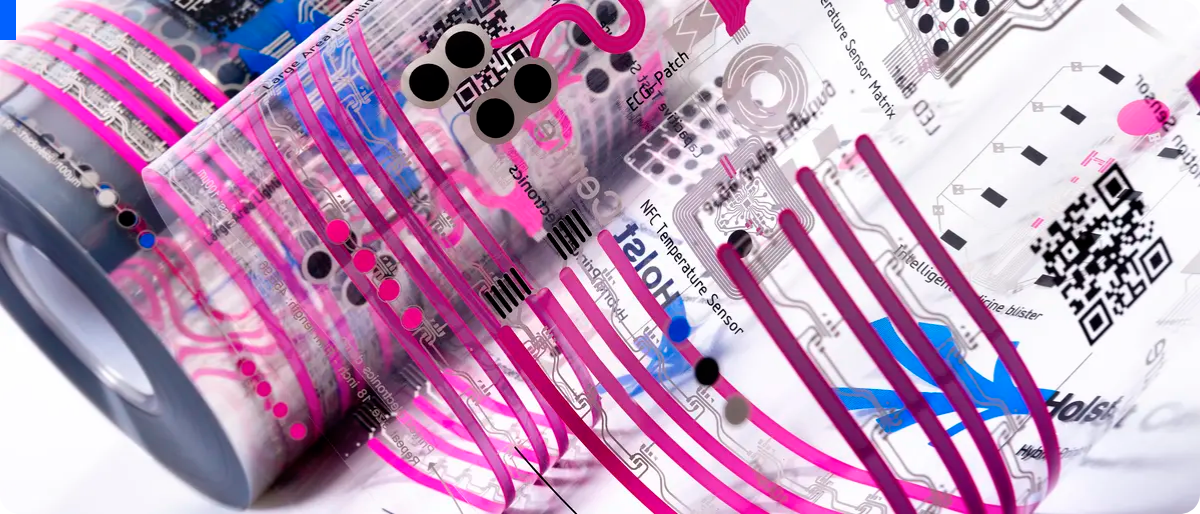
Can printed electronics offer a scalable alternative to conventional printed circuit boards? TNO at Holst Centre spin‑off TracXon is showing how a technology developed in the lab can move towards industrial‑scale production.
Electronics are everywhere, but the way they are manufactured comes with a significant environmental footprint. Conventional printed circuit boards (PCBs) rely on resource‑intensive production processes and generate substantial material waste.
TracXon is taking a different approach. The company develops hybrid printed electronics by printing electronic circuits onto thin, flexible materials. Its additive manufacturing process uses only the material needed to create the circuit, rather than removing material from a larger substrate.
Five times lower carbon footprint
According to TracXon, its printed electronics have around a five times lower carbon footprint than conventional PCBs, require substantially less material and energy, and use no water during production. The technology also enables lightweight and flexible electronic circuits for applications ranging from wearables and Internet of Things devices to large‑area lighting and displays.
“Our printed electronics have a five times lower CO₂ footprint, use ten times less material, and consume five times less energy, all without using water in the process,” says Ashok Sridhar, co‑founder and CEO of TracXon.
From research to industrial scale
TracXon emerged from technology developed at TNO at Holst Centre, where research into printed electronics has been carried out for many years. The company was founded to take that technology beyond laboratory‑scale development and make it available to industry at scale.
That transition is already under way. Since its foundation in 2022, TracXon has worked with more than 20 customers across ten countries on hybrid printed electronics products. In 2025, the company raised €4.75 million in seed funding to further industrialise its technology and develop new roll‑to‑roll production equipment.
The company’s ambition is not simply to demonstrate that printed electronics work, but to create the manufacturing technology needed for broader adoption.
European recognition for sustainable electronics
That potential has also been recognised by the European Commission’s Innovation Radar, which highlights the Eco‑designed In‑Mold Electronics (IME) innovation. The recognition reflects growing European interest in technologies that can combine advanced electronics with more sustainable manufacturing approaches.
For TracXon, this comes at an important stage in its development: moving from successful applications and customer projects towards larger‑scale industrial deployment.
Building a deep‑tech company around technology
A technological breakthrough alone is not enough to create impact. Technologies also need entrepreneurs, investment, industrial partners and a clear route to market.
This is where venture building plays an important role. TNO at Holst Centre supports the transition from applied research towards commercialisation by connecting technology with entrepreneurial expertise, investors and industry.
TracXon illustrates that journey: from years of research in printed electronics to a deep‑tech company developing both products and the equipment required to manufacture them at scale.
In a recent episode of BNR Nieuwsradio’s De Grote Tech Show, Sridhar discusses the company’s next phase of growth and its ambition to expand its production footprint. The interview also explores the opportunities for flexible and printed electronics as manufacturers look for new ways to reduce material use while adding functionality to increasingly connected products.
For TNO at Holst Centre, TracXon demonstrates what happens when applied research is combined with entrepreneurship: technology moves beyond the laboratory and towards industrial impact.