

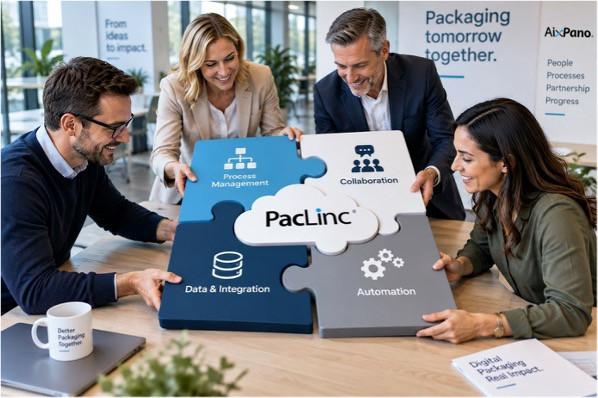
Process platforms connect customers, sales, engineering and production within a seamless digital process. This is achieved on the basis of a context-based database that centrally consolidates all product-related information – from material and design data, through to graphic elements and tools, right through to contracts, stock levels and call-off agreements. The result is a seamless information chain spanning all process steps.
Customers expect rapid responses, transparent order information, flexible call-offs and reliable execution, even for complex products. To achieve this, numerous processes in the packaging industry must work in tandem – spanning sales, internal services, development, CAD, pre-press, procurement, production, warehousing and logistics.
In many companies, the information required for this is still scattered across different systems and communication channels. ERP applications, emails, local files, Excel spreadsheets and individual expertise often form isolated ‘information silos’ that exist side by side. Whilst such structures may function well in day-to-day operations, they make it difficult to manage and scale complex processes across multiple plants, customers and suppliers.
Newly developed platforms offer the possibility of connecting these silos. In doing so, they bring together tasks, data, communication and approvals within a shared context. One such platform is PacLinc from AixPano. It serves as a unifying process layer rather than a replacement for individual applications. It makes it clear and traceable who is working on which task, which information is valid, which version has been approved and what the next step is. Scattered processes are transformed into a traceable workflow that can be managed, analysed and improved by staff.
Actively managing processes rather than collecting information
A key component of digital process and collaboration platforms is task-based process control. It establishes clear responsibilities and reduces the need for coordination. Employees no longer need to search through email threads for the latest status or check across different systems to see which file is the correct one. Relevant information is available exactly where it is needed: linked to the product, the order, the enquiry or the approval, and can be viewed there.
This enables managers to track workflows whilst they are being processed and to identify potential bottlenecks, rather than merely assessing them retrospectively. Bottlenecks, pending decisions or missing information thus become apparent earlier. Digital systems help to actively organise work, rather than simply documenting the past.
Digital customer engagement
Digital process and collaboration platforms also take into account the extremely important interface with the customer. In the packaging industry, a customer relationship often begins well before the actual order is placed: with an enquiry, an idea, a change to an existing item, an approval, a stock check or a call-off. For the customer, it is not just the physical product that counts, but the quality of the entire process – and thus the transparency and reliability of the whole workflow.
A digital platform makes this information accessible and integrates customers into defined processes such as product versions, enquiry and approval statuses, stock levels or delivery dates. The customer gains greater autonomy because they can retrieve information themselves, track processes and make decisions more quickly. The packaging manufacturer reduces the need for follow-up enquiries, speeds up processes and strengthens customer loyalty. Digital customer engagement thus becomes more than just portal access: it becomes a key differentiator.
Process data for management
Communication platforms track operational data directly within the process. This includes, for example, lead times, enquiries, approval steps, processing statuses or recurring sources of error. This information can be analysed and utilised for process control.
Presented in dashboards and business intelligence functions, they highlight where processes are functioning well and where action is required. Management gains insight not only into individual orders but also into patterns across the organisation: Which process steps cause delays? Which customers or product groups require intensive support? Where is standardisation worthwhile? Which workflows can be automated? In this way, process digitalisation becomes a tool for corporate management. Decisions are based less on individual impressions and more on reliable process data.
Continuous development
However, digitalisation is not complete with the introduction of an IT system. Technological developments, customer requirements, security standards, interfaces and organisational processes are constantly changing. Accordingly, a process platform must also be continuously developed and adapted to new requirements.
Feedback from production sites, the customer portal and management serves as the starting point for further optimisation. New functions arise from real-world requirements: improved retrieval processes, more precise analyses, additional interfaces, simplified approvals or new service offerings. In this way, a platform grows alongside the company and its customer relationships.
Jörg Fischer, Managing Director of AixPano and provider of the PacLinc communication platform, describes the advantages of digital process platforms as follows: “The platforms connect people, data and decisions within a shared process framework. This is precisely where the strategic value lies for packaging companies that wish to scale their processes and integrate their customers more closely through digital means.”
“The platforms connect people, data and decisions within a common process framework. This is precisely where the strategic value lies for packaging companies that wish to scale their operations and integrate their customers more closely through digital means,” says Jörg Fischer, Managing Director of AixPano B.V., describing the advantages of digital process platforms.
The foundation for automation and AI
A structured process database is also a prerequisite for more advanced automation functions. Artificial intelligence can be utilised and deployed where tasks, documents, status information and decisions exist within a traceable context.
In the long term, this could give rise to assistance functions that, for example, check the completeness of enquiries, identify missing details, prioritise critical tasks, summarise communication histories or forecast potential delays. The key factor here is not AI as an additional function, but its integration into an existing process. Only when data and responsibilities are structured can automated assistance functions be deployed reliably and in a traceable manner.
Integration rather than siloed solutions
For packaging companies, the strategic benefit of communication platforms does not lie in a single function. It arises from the combination of internal process control, digital customer engagement, context-based data management, integrated communication and management transparency. The platform transforms distributed workflows into a shared digital process space.
Digital process platforms represent an approach in which internal process control, customer engagement, communication and management analysis are brought together within a single digital process space. The focus is therefore not on a single application, but on linking existing workflows and information.
They build on the previous stages of digital transformation and take them further: from the standardisation of internal processes, through the digital customer platform, to data-driven control and future AI-supported process automation. Digitalisation thus becomes a permanent organisational principle – and a building block for operational excellence, customer loyalty and future-proofing in the packaging industry.
Written by Dieter Finna. Further information: www.aixpano.nl