

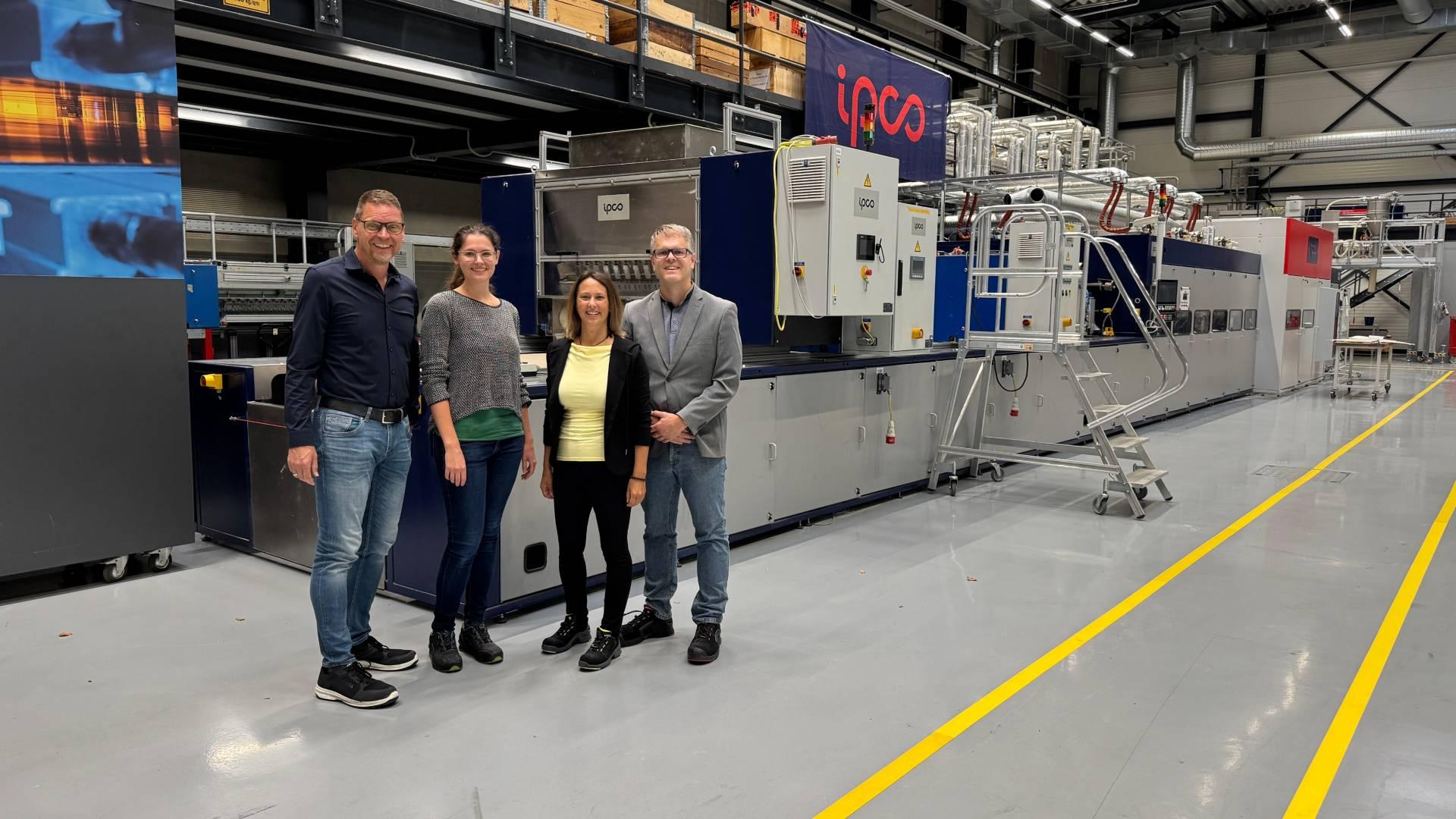
IPCO is consolidating its testing and engineering expertise in Fellbach. PRO Flexconvert spoke to Nora Topp, Head of the Productivity Center, and Global Product Manager Film Casting and Jens Gegner, Global Segment Manager for Composites, about the new Productivity Center, developments in the composites market and the importance of bespoke solutions.
IPCO has set up a new Productivity Center in Fellbach. What was the reasoning behind this?
Nora Topp: Historically, our testing activities were spread across two sites: in Göppingen, the focus was on double belt presses, whilst the solidification and film casting were based in Fellbach. Time and again, customer projects have shown that it would make sense to bring both technologies closer together. For example, a customer might carry out tests in Göppingen and then realise that an additional test on a machine in Fellbach would be worthwhile – or vice versa. With the new Productivity Center, we have now brought these areas of expertise together at a single site. This is a major advantage for us. We have staff who each possess a great deal of experience in their specific fields, but who can also support one another. This enables us to cover a significantly broader range of tests.
What is the scale of the site?
N. Topp: Around 150 staff work in Fellbach. Worldwide, IPCO employs around 650 staff. Fellbach is an important engineering site and, at the same time, our largest test centre for film casting and composites. Further testing facilities are available, for example, in Milan, Japan, the USA and China.
What capabilities does the Productivity Center offer in the field of film casting?
N. Topp: Here, we have a highly versatile pilot plant with three independently controllable drying zones. It can simulate a variety of application technologies. Another special feature is our patented Venturi dryer. This is particularly suitable for products that tend to form a skin. At the same time, we can convert the section to a counter-current dryer if required. This gives us a great deal of flexibility. If a product requires an additional process step, we can integrate this too – for example, re-wetting or humidification using moist air.
What products are typically tested here?
N. Topp: The range is broad. Among other things, we work on films and membranes. This extends into very thin areas – the thinnest product we have produced on the line was just five micrometres thick. Applications can be found, for example, in the medical sector, in separator membranes for batteries, in optical films or even in packaging films. It is precisely this breadth that interests us.
How does a typical customer project unfold?
N. Topp: It varies greatly. Some customers come to us with a concrete idea and extensive preliminary tests. Others, particularly start-ups, are still right at the very beginning of product development. In such cases, it’s a joint challenge to work out which process will actually work. We don’t just have our large-scale plants for this. Using a static press, for example, we can produce samples in A4 format. This is helpful when a customer isn’t yet sure exactly which binder or which pressure is suitable for their product. The next step is then to move on to the continuous pilot plant. This is hugely important to us because it also allows us to identify effects that might not become apparent during a batch trial. A large proportion of the plants we sell have previously been tested in some form at our test centre. Without this facility, the design process would be significantly more difficult for both us and the customer.
So the test centre is not just a demonstration facility, but an essential part of the engineering process?
N. Topp: Absolutely. We learn a great deal ourselves from every test. At the same time, this reduces the risk for the customer. A product must function under realistic conditions before we design an industrial plant based on it. Another advantage is the physical proximity between the test centre and the engineering department. We can carry out a test and then work with the design engineers to consider how the results can be applied to a complete plant design. This direct exchange is particularly valuable when it comes to bespoke machinery.
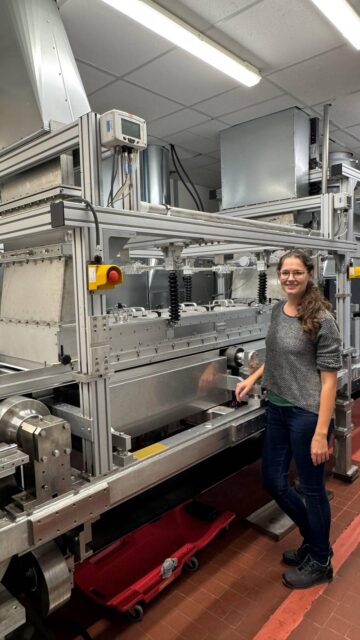
Nora Topp in front of the pilot film casting plant
Mr Gegner, how is the composites market currently developing?
Jens Gegner: The composites market is very broad and subject to significant shifts. In the past, for example, we were very strong in the flooring sector and built large systems for laminate and backing applications. We have systems in operation with lengths of up to 80 metres and featuring several spreaders. Later, glass-PP applications and the automotive sector, amongst others, were added. Today, we are seeing a very strong trend towards recycled materials. We have further developed our spreading technology to meet this demand. With our new spreaders, we can now process long-fibre materials with fibre lengths of around 25 to 50 millimetres.
What role does press technology play in this?
J. Gegner: A very significant one. IPCO is the only supplier worldwide to have both PTFE belt presses and steel belt presses in its portfolio and to be able to combine these technologies in what is known as a ‘combination press’. In doing so, we combine the advantages of a PTFE belt – in particular its good release effect – with the surface pressure of a steel-belt press. Another key advantage lies in temperature management: the pressing module does not require additional cooling. This helps to reduce energy consumption. Our Productivity Center enables us to simulate different pressing ranges and test this technology with the respective materials and processes.
How customisable are such systems?
J. Gegner: Highly customisable. Whilst we have standardised many aspects, in the composites sector many machines are ultimately one-offs. We adapt the system to the specific process. We have already supplied systems in which a long, continuous lower belt was combined with two separate press heads. This enabled us to resolve certain process issues relating to release whilst simultaneously integrating additional process steps. This is precisely where one of our strengths lies: the customer comes to us with an idea, and together we develop it into a finished product or an industrial process.
What role do start-ups and research organisations play in this?
J. Gegner: Start-ups are of great interest to us because they often develop completely new products and do not yet have an established process route. This makes the projects challenging, but also exciting. We also collaborate regularly with research organisations and institutes.
N. Topp: And the Productivity Center gives us the necessary flexibility for this. If an experiment was originally planned for just one piece of equipment and it becomes apparent during testing that another technology would be useful, we can react relatively quickly. Thanks to the consolidation of staff and equipment, this is now much easier.
Sustainability is a major issue in the composites sector. What developments are you observing?
J. Gegner: Recycling is playing an increasingly important role. With composites in particular, the aim is to reintegrate recycled materials into industrial processes. Our spreading technology offers interesting possibilities in this regard, especially when longer fibres are to be processed. At the same time, we’re seeing markets develop differently across regions. The US is currently very interesting, but Japan is also an important market. And we’re currently seeing increased activity in Europe again as well.
Overall, the markets for IPCO appear to be relatively stable, despite the challenging environment.
J. Gegner: Our broad portfolio helps us a great deal. When one market weakens, there are often other sectors that are performing well. During the COVID-19 pandemic, for example, film casting for membrane applications was very strong. Today, we are seeing high demand in the ballistics sector, amongst others. These are also composite applications – for example, protective plates for personal protective equipment or solutions for military vehicles. We are currently seeing a great many enquiries from this sector once again.
Some months ago, IPCO acquired the long-established US company New Era Converting Machinery. How do you work together now?
J. Gegner: We regularly receive enquiries where we realise that the technology is a better fit for New Era. Conversely, New Era receives enquiries where a solution from IPCO makes more sense. This collaboration offers interesting synergies. This applies to both film casting and winding and pressing technologies in the composites sector. New Era’s strong presence in the USA is particularly interesting in this regard. In fact, the two companies are located only around ten miles apart there. Particularly in light of current customs and trade developments, local manufacturing and assembly expertise is an advantage. This enables us to produce and assemble more directly in the USA.
How is IPCO responding to the increasing competition from Asia?
J. Gegner: When it comes to standard machines, the price pressure from China is, of course, enormous. We experienced this trend at an early stage. Around 15 years ago, we supplied our first PTFE tape presses to China. Later on, some of these machines were copied. Our response cannot, therefore, be to compete on price. Our strength lies in the high-end sector, in bespoke solutions and in turnkey projects. When it comes to specialised surfaces, complex materials or highly customised processes, our expertise is crucial. For example, we have customers who still deliberately choose us because they value our process expertise and quality. That is precisely where we need to excel.
Does that include after-sales service?
J. Gegner: Absolutely. We don’t simply deliver a machine and walk away. A complex press, in particular, requires support throughout its entire life cycle. We have local service and support structures worldwide, which enables us to reach the customer quickly. That’s a significant added value. A technician doesn’t have to wait weeks for a visa when a problem arises. We have trained staff on site.
Looking ahead: what is the key message of the new Productivity Center?
N. Topp: For me, it’s above all our proximity to the customer. We can develop, test, identify problems and find solutions together with them. And in doing so, we can draw on the experience of our staff across a range of technologies.
J. Gegner: Exactly. Ultimately, it’s not just about selling a machine, but about understanding the process. When we understand the customer’s product and develop the optimal solution together with them, this leads to a long-term partnership. The Productivity Centre is a crucial interface for this.