

Two projects from KOCH Robot Systems show that packaging and palletising rolls no longer has to be a feat of strength.
Nonwovens, adhesive tapes and technical films are true all-rounders: they protect, insulate and connect, making them indispensable in medicine, hygiene and industry. Their value only becomes apparent at the end of the production chain: only when the materials are precisely wound onto rolls, securely packaged and further processed can they fulfil their function.
However, this is precisely where bottlenecks often arise: rolls can reach over a metre in diameter and weigh several thousand kilograms. Nevertheless, stricter hygiene requirements often have to be taken into account for these sensitive surfaces. Manual handling is time-consuming, error-prone and often not gentle enough on employees.
Automation offers the solution here: robot systems take over the precise winding, packaging and palletising – quickly, reliably and reproducibly. Two independently implemented automation projects by KOCH Robot Systems impressively demonstrate how these challenges can be mastered even with a high degree of variety and complex production requirements.
When rolls become heavier – and processes smarter
Nonwovens, adhesive tapes and technical films may differ in material, size and weight, but the challenge in production remains the same: large diameters, sensitive surfaces and high cycle rates meet the demand for 24/7 reproducible processes.
Two companies in the chemical industry were also faced with this situation and independently rethought their roll packaging and palletising processes. Both produce high-quality, functional materials for demanding applications – one in the field of hygiene closure systems and technical adhesive tapes, the other as a materials specialist for nonwovens and plastics. Different products, similar reality in production: their rolls vary between 450 mm and 1,130mm in diameter and weigh between 8 and 1,300 kilograms.
“The question was never whether to automate, but how we could make the processes efficient, flexible and future-proof,” explains Jan-Henning Röseler, converting expert at KOCH. “With such variable rolls in particular, it is clear that only an integrated approach combining mechanics, robotics and data logic can deliver stable results.”
From roll to ready-to-ship pallet – a well-coordinated process
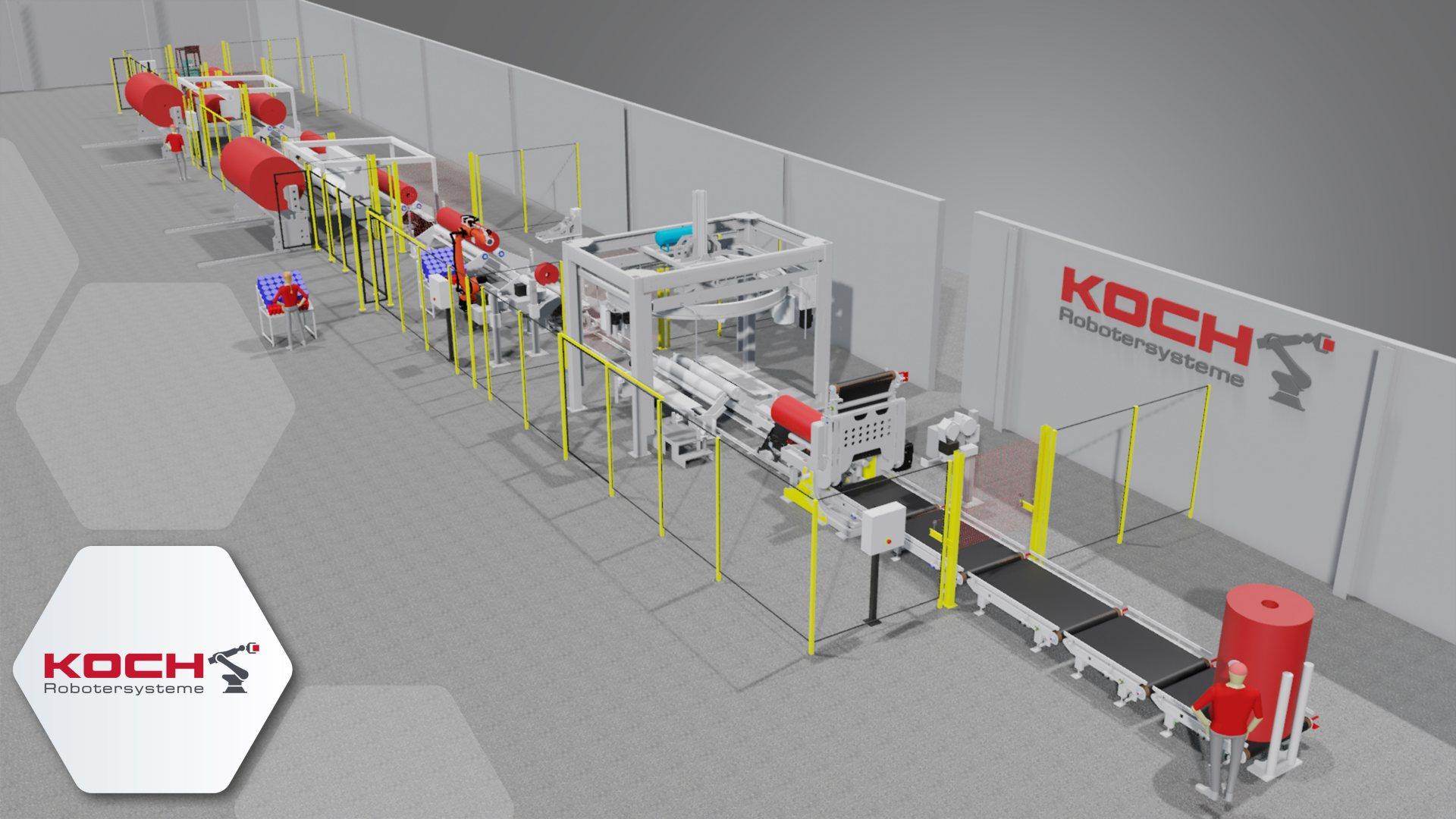
In both projects, the plant process follows a clearly structured, consistent principle: each roll is picked up individually, clearly identified and processed automatically step by step. From initial contact to the pallet ready for shipment, robotics, conveyor technology, mechanics and software work together seamlessly. This is based on KOCH Engineering’s preliminary work: detailed analyses, application-specific development work, 3D simulations and VR inspections, which check the plant design for efficiency and feasibility right from the start.
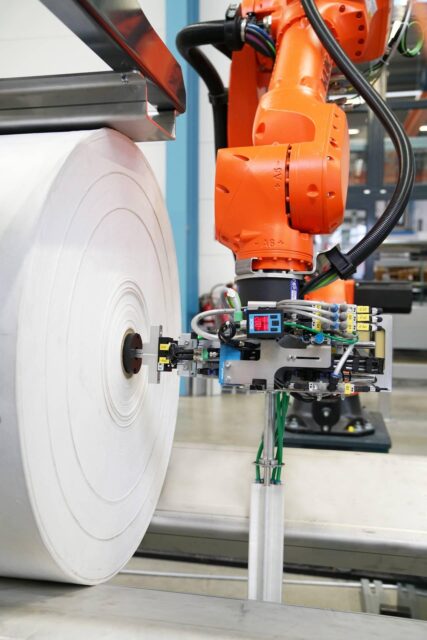
Thanks to this engineering, the subsequent planning and detailed project support – including project management, installation, setup, virtual commissioning and training – these process steps run smoothly and efficiently, even with a very high variety of variants and heavy rolls: The product is picked up by an unloading robot with a KOCH gripper.
This device is equipped with a suction unit, a mandrel, a clamp and sensors to detect the shaft and product to be removed.
Depending on the system, unloading is carried out in eye-to-wall or eye-to-sky alignment. Each roll is then labelled. Special labelling robots with integrated barcode scanners automatically check and verify the legibility of the label, thus ensuring traceability. This is followed by packaging: the wrappers take care of axial or radial wrapping, and depending on the order specifications, the KUKA KR 50 R2500 robot then adds end caps, discs or cut-resistant cardboard, regardless of roll diameter, weight and product type.
The real heart of the system is robot-assisted palletising: a KUKA KR 600 R2830 with a payload of up to 350 kg picks up the rolls individually with specially developed clamping or suction grippers, positions them accurately with a cycle time of 60 seconds and builds flexible stacking patterns. It does not matter whether there is one roll per layer, several rolls next to each other or in bundles, single or multi-layered – the pallet image is automatically generated from the stored product data. This allows a robot to place up to 120 rolls per hour on the pallet.
Cross transfer carriages connect several lines with each other and ensure that packaging, palletising and load securing can run in parallel and without downtime. Finally, the pallets are strapped or wrapped, labelled and transported via conveyor technology to the full pallet acceptance area – ready for the forklift and the next process step.
“The integration of robotics and software allows us to automatically generate even complex pallet images – this reduces errors and significantly increases process stability,” adds Röseler.
Continuous data collection – and interpretation
Mechanics, robotics and software work hand in hand. Each roll comes with its own data set, which is checked, stored and virtually carried along the entire plant route. This data not only determines the type of packaging and palletising pattern, but also ensures that errors are detected at an early stage.
Unplausible information does not lead to production disruptions, but to clear instructions for the operating personnel. Rolls can be specifically ejected, data corrected and processes continued – without bringing the entire system to a standstill. At the same time, data-based control enables multiple orders to be run in parallel and pallets to be temporarily stored if priorities change at short notice.
“Complex roll processes in particular demonstrate how crucial the interaction between mechanics, robotics and data logic is,” explains Jan-Henning Röseler, converting expert and business development manager. “Only when all three areas are neatly interlinked can a truly stable and scalable process be created.”
Lasting relief – automation as the answer to the shortage of skilled workers
In addition to efficiency and process reliability, another aspect plays a central role in both projects: relieving the burden on employees. Manually moving or palletising rolls weighing several hundred kilograms is not only physically demanding, but also incompatible with modern working conditions in the long term.
Through automation, robots take over precisely those tasks that are classified as heavy, repetitive and ergonomically critical. Employees are not replaced, but rather relieved of specific tasks. They monitor the processes, intervene when necessary and can concentrate on quality-related tasks. Against the backdrop of an increasing shortage of skilled workers, automation is thus becoming a strategic tool.
Automation as the key to efficiency and future security
The examples clearly show that automation in roll handling is no longer an optional luxury, but a decisive factor for efficient, safe and stable production processes. Robots take on heavy, repetitive and ergonomically stressful tasks, reduce the potential for errors and ensure that material flow, packaging and palletising are reliably interlinked.
Both companies made a conscious decision to choose KOCH robot systems – not least because of the company’s many years of experience in the converting industry and its role as a pioneer in this field. The decisive factors were the modular KOCH Big FIVE structure, which can be flexibly adapted to different rolls, weights, product types and production conditions, and the comprehensive engineering, which enables stable and scalable process solutions. This enabled the companies to efficiently implement their complex automation requirements without having to develop new technologies themselves.
This makes it clear that automation is not only a means of increasing efficiency, but also a strategic tool that supports production, quality and employees in equal measure – and makes companies sustainable for the future.