

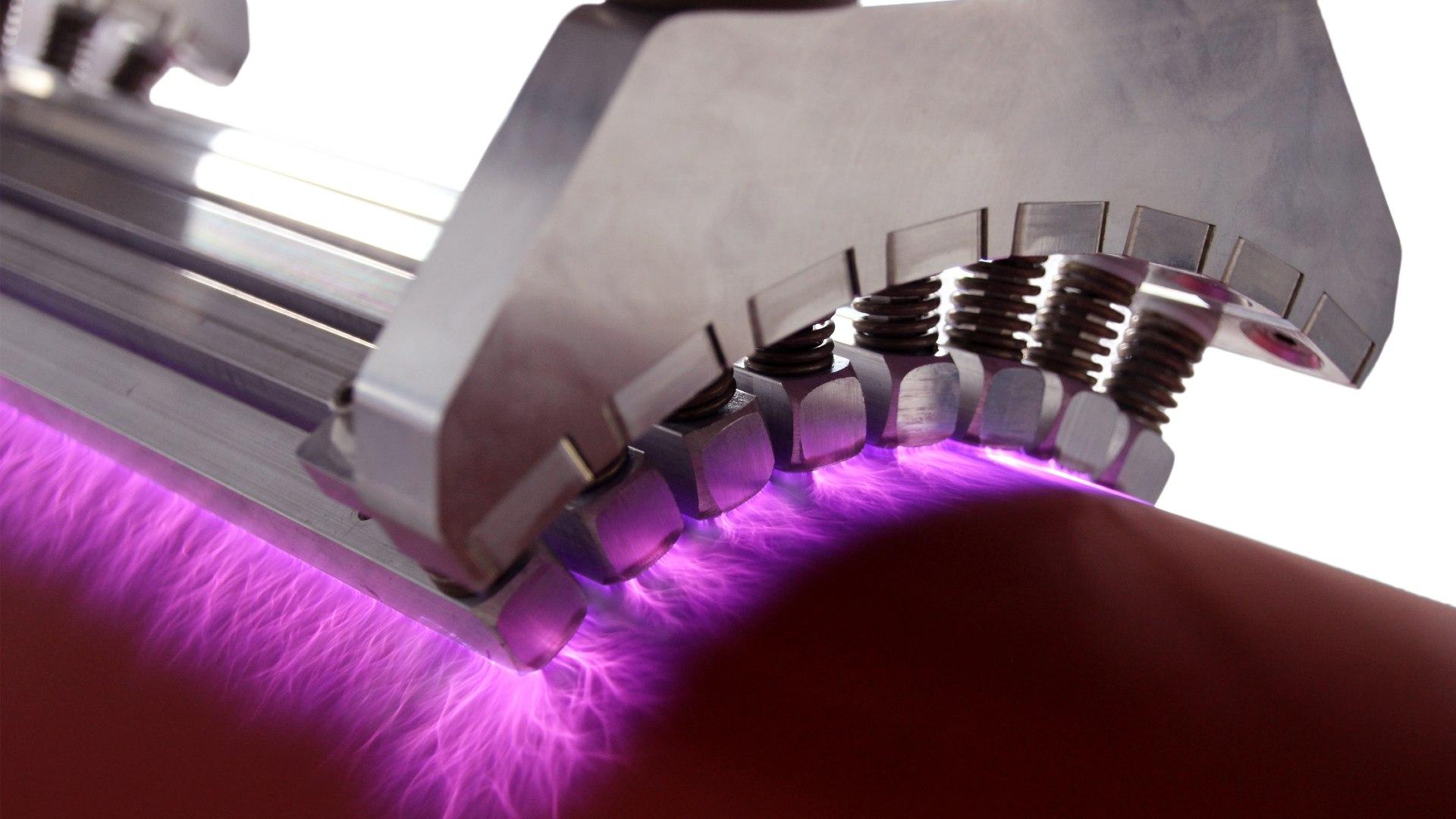
With the LOUPE Americas expo in Chicago about to showcase the latest in digital print technology, surface treatment pioneer Vetaphone provides this useful Q&A check list for converters using non-absorbent substrates.
Q: Does digital printing place different demands on surface treatment?
A: With the exception of the inline primers that certain manufacturers recommend, there are no other special surface treatment requirements for substrates that are printed digitally, whether by toner or inkjet process. In practice, the vast majority of substrates that can be printed offset, flexo, or gravure, can also be printed digitally. It’s not the print process that determines the need for and level of surface treatment but the substrate itself and its ability to accept ink or lacquer without smudging.
Q: Are digital inks different to offset and flexo?
A: Yes, because they contain plastic polymers and oil. These have a very low surface tension and therefore offer poor adhesion, which can pose problems for any post converting process. And the higher the ink coverage, the worse the situation becomes. Good quality corona treatment secures the bonding.
Q: Does digital printing require pre-treated stocks?
A: It’s well accepted that digital presses, whether toner or inkjet, require a pre-conditioning of the substrate before it’s printed. This can be an expensive process, especially as the quality of the pre-treatment can vary. At Vetaphone, we are currently involved in a series of extensive lab tests to evaluate how to overcome the need for printers to buy expensive pre-treated stock. Corona treatment can often provide a more cost-effective and reliable solution, so do check with us first.
Q: Are there examples of corona treatment in action on digital presses?
A: There are many, including HP installations where there is an ILP unit. The user applies corona before priming, and again after printing, and in some cases, once again to seal the UV coat before other decorative processes are added. Corona treatment builds in a degree of security at each stage to ensure quality and consistent performance.
Q: How do I know which surface treatment is right for the jobs I’m printing digitally?
A: There are three clearly definable requirements, or categories. The first is where there is a need for simple corona treatment, and this applies to virtually all narrow web press applications. It will typically require a corona unit to deliver a power rating of 2.0 – 3.0 kW and provide excellent performance on standard substrates run off at low to medium speeds. Generally, this is suited to the majority of digital press applications today.
Q: Do the new wider and faster presses change the surface treatment requirements?
A: This falls into the second category, which has been created by the development of new and more difficult substrates. They are run off on the latest generation of presses that have been optimised by manufacturers for high-speed production. These factors place an increased demand on the corona unit to deliver the correct dyne level, which typically needs to be rated at 3.0 – 5.0 kW. To understand this concept, think of the similar situation with UV curing, where dwell time under the lamp, defined by power rating and running speed, are critical to achieving a complete cure.
Q: Is corona the answer to all surface treatment requirements?
A: Most, but not all. This is the third category and relates to substrates that have been developed to produce ‘unique’ labels, typically using special inks and lacquers, lamination, multi web applications and other techniques to produce sophisticated products. The chemical constituents of these substrates require a chemical treatment process as well as a physical one – and in these instances plasma treatment is necessary to ensure bonding. Plasma should not be considered as a replacement for corona, more a logical development of technology to keep pace with the requirements of more sophisticated materials and processes. At present, this technology is outside the requirements of digital printing.
Q: How is Vetaphone corona different from others?
A: The real secret of corona treatment is managing the power output, and this is what sets Vetaphone apart. Controlled power is essential in surface treatment, and Vetaphone generators’ ability to proportion the output power from 1 – 200kW related to line speed in a smooth and uniform manner removes the risk of pinholes in the substrate. Power regulation uses the ultra-fast Pulse Width Modulation (PWM) technique. This is easy to manage via the iCC8 multi-lingual operator panel that allows remote control from the central line console. All the electronics in a Vetaphone generator are modular for fast exchange and reduced downtime.
Q: What’s your advice if you’re unsure about the right way to go with your digital press?
A: Come and talk to us. Vetaphone invented corona surface treatment 75 years ago so has more experience and knowledge than any other manufacturer. It doesn’t matter if your requirement is a simple low-power unit or a more complex station for high corona dosage at fast speeds. The important bit is the ability of the generator to switch between read-out modes that display either power output in kW, or energy delivered in Watt x min/ft². It’s no good having power without the ability to control it – that’s the Vetaphone difference!