

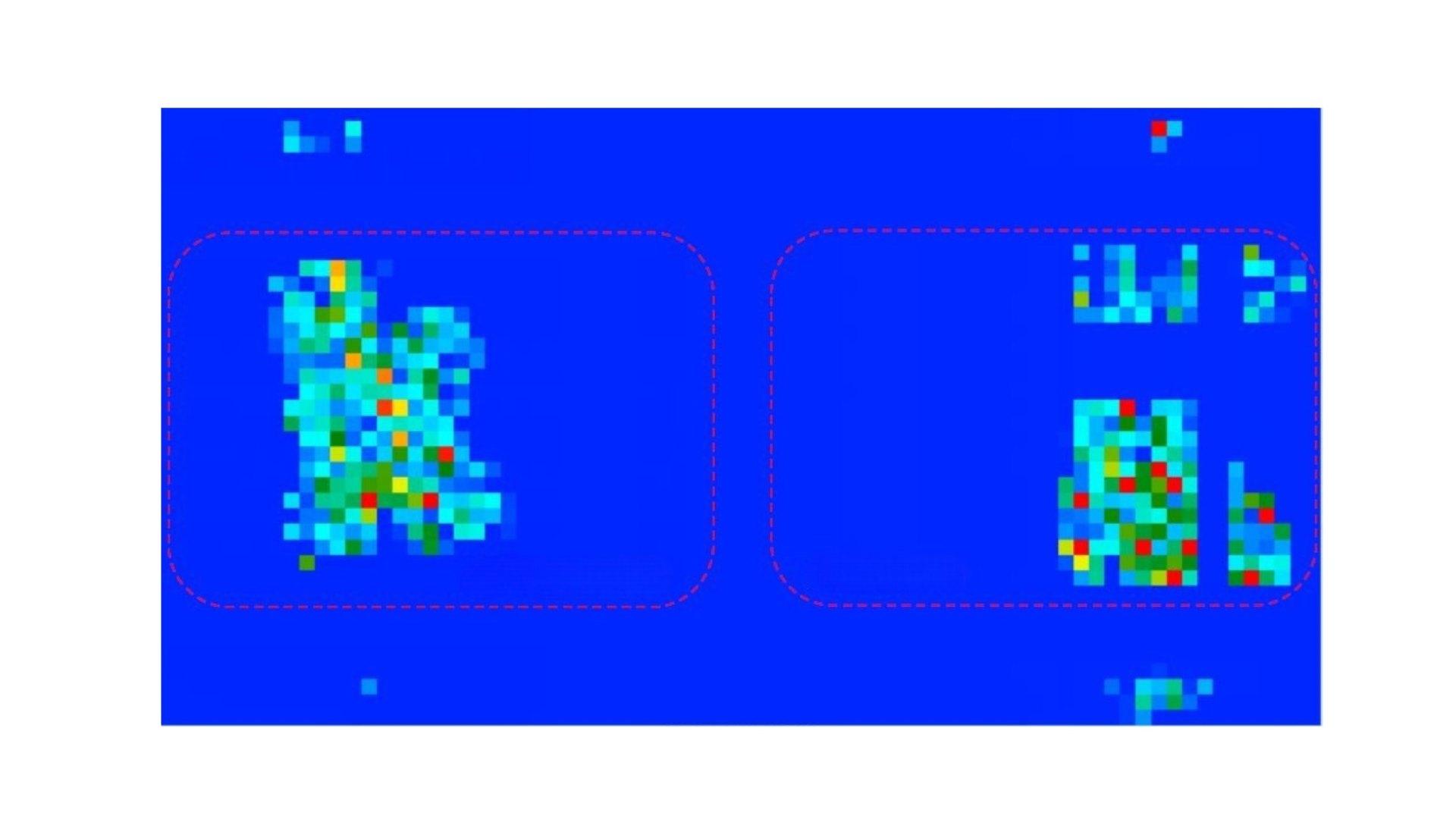
FLEXOO and Zhuojun have launched their first joint development project, placing seat comfort at the centre of next‑generation automotive differentiation. In the Chinese automotive market, seat comfort is a decisive purchasing criterion -particularly in the premium and upper mid‑range segments, where expectations far exceed basic ergonomics.
The project focuses on printed seat sensor technology designed to significantly enhance comfort by transforming physical interaction into high‑resolution, real‑time data. The objective: to raise expectations for Occupant Classification Systems (OCS) and establish a new benchmark for comfort‑driven vehicle interiors.
High‑resolution pressure mapping instead of binary signals
Conventional OCS approaches often rely on simplified, binary signals. The joint FLEXOO–Zhuojun solution takes a fundamentally different path. High‑resolution pressure mapping captures the complete spatial distribution of pressure across the seat – rather than simple on/off states. This enables a far more precise understanding of how occupants interact with the seat in real‑world conditions.
The result is premium comfort delivered, delivered through data granularity that allows automotive OEMs to differentiate not just through materials or design, but through measurable performance.
Individual passenger intelligence for personalised comfort
The printed seat sensors enable individual passenger intelligence by detecting:
- Seating position,
- Weight distribution, and
- Posture dynamics.
This data forms the basis for personalised comfort profiles, allowing the OCS to respond to each occupant individually. Instead of static preset configurations, comfort becomes adaptive, driven by real behaviour, not assumptions.
Dynamic comfort optimisation in real time
One of the most compelling aspects of the project is dynamic comfort optimisation. Based on real-time driver classification, the system can automatically adjust air cushions and comfort elements within fractions of a second. Overarching activation systems for passenger-specific seat adjustment can be triggered almost instantly, translating sensor data directly into physical response.
This capability allows vehicles to excel in two critical evaluation moments:
- The first 10 minutes, when showroom impressions are formed, and
- Long‑range driving scenarios, where sustained comfort determines long‑term satisfaction.
First test results exceed expectations
Initial tests within the joint project have already been completed, delivering very promising results. Both the reaction time and the resolution of the measured pressure distribution exceeded initial expectations.
Most importantly, the tests confirm that previously inaccessible data spaces in automotive seating can now be measured, interpreted, and transformed into actionable insights – a decisive step forward for OCS‑based seat comfort systems.
Printed sensors and printed cabling unlock system advantages
A key differentiator of FLEXOO’s technology lies in its manufacturing approach. Not only are the sensors themselves printed, but also the data transmission cables.
This allows:
- Precise adaptation to individual system configurations,
- Simplified integration into complex seat architectures, and
- Significant cost savings compared to conventional wiring approaches.
For OEMs, this means greater design freedom without a cost penalty – an increasingly critical factor in today’s competitive automotive landscape.
Seamless integration without changing seat feel
The ultra‑thin sensor matrices are designed for seamless integration into existing seat constructions. Importantly, they do not alter the haptics or seating feel that designers and OEMs have carefully engineered.
From the occupant’s perspective, comfort simply improves – without visible or tactile compromise.
Modular sensor matrices accelerate development cycles
Another strategic advantage is the modular design of the seat sensor matrices. This modularity enables extremely fast testing across different seat variants and vehicle configurations.
Combined with the additive manufacturing process, this leads to:
- Shorter development cycles,
- Faster validation, and
- Clear time‑to‑market advantages.
Cost efficiency and speed scale together – an increasingly rare combination in automotive interior innovation.
Winning the comfort battle with data
The first joint project between FLEXOO and Zhuojun shows how seat comfort becomes a data‑driven differentiator. In a market where expectations are rising rapidly, the ability to translate physical interaction into instant intelligence is becoming a competitive necessity. For automotive OEMs targeting China, the message is clear: those who master advanced OCS capabilities and real‑time seat comfort data will define the next benchmark – while others risk being left behind.