

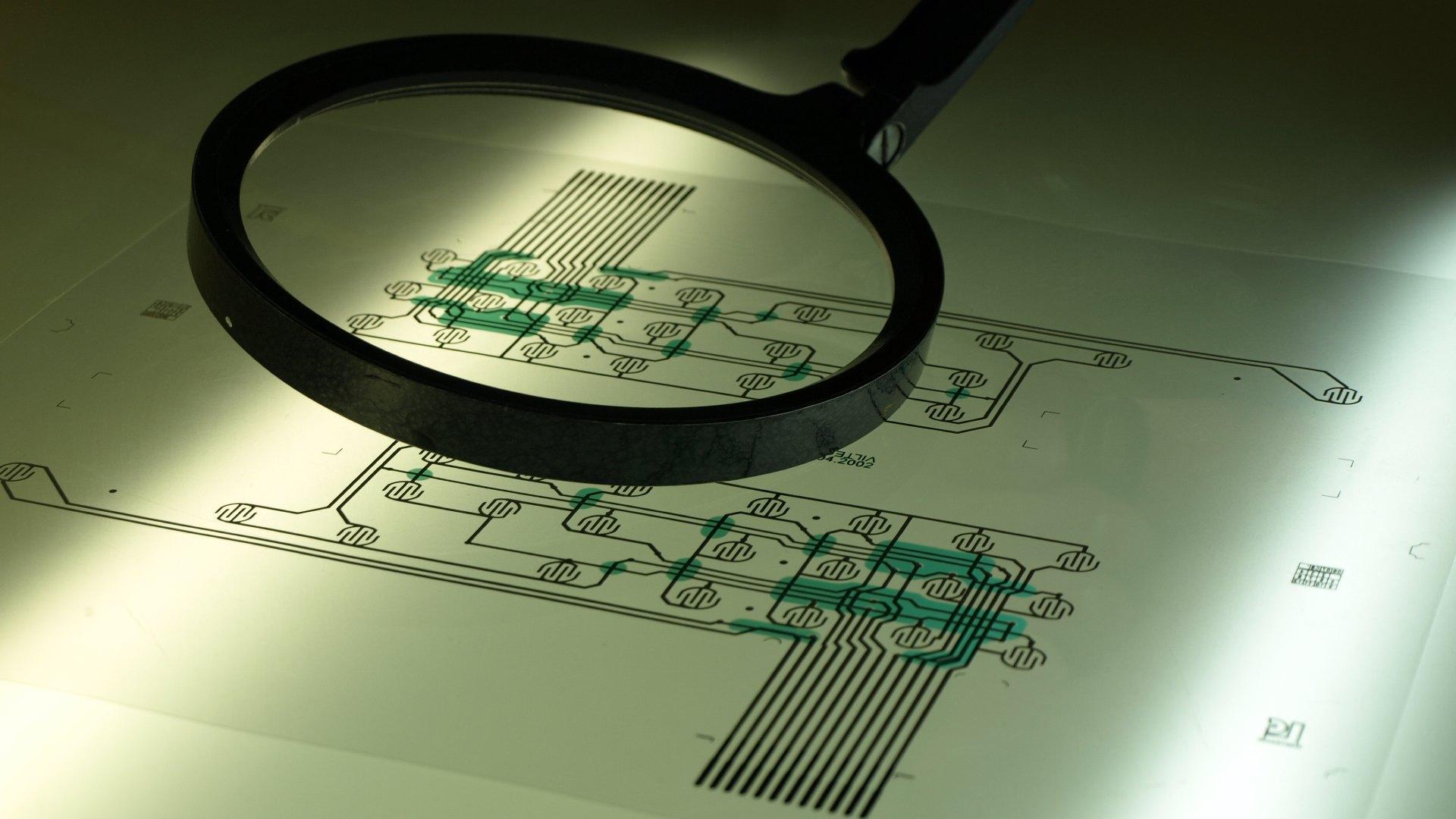
We often assume that newer means better. A newer machine must be better than an older one, and a newer printing method must surely be more suitable for modern electronics than a process that has existed for more than a hundred years.
Then we enter a factory producing printed electronics and discover something interesting. Silver tracks, carbon layers, dielectrics, sensors and heating elements are still often made by screen printing. Not because the industry has failed to invent anything newer. Today we also have several other printing technologies. Screen printing remains important because in many applications it gives industry exactly what it needs: a controlled amount of functional material, deposited in a repeatable way.
Printing a function
Printed electronics is not traditional printing with a more expensive ink. We are not printing a picture. We are printing a function. A line can carry current. Another layer can work as a resistor. A dielectric can separate two conductive paths. So the key question is not only how sharp the line looks. We also need to know its resistance, thickness, uniformity and whether print number 5,000 behaves like print number 50.
This is where screen printing has a strong advantage. It allows us to control not only where material is deposited, but also how much reaches the substrate. In one typical dielectric process, a 61 threads/cm screen can give a dry layer of about 25 µm, 77 threads/cm around 18 µm and 120 threads/cm around 10 µm. For insulating crossovers, a total thickness of 25–30 µm may be required, often built in two passes.
That may sound like a production detail, but it directly affects function. If a dielectric is too thin, insulation can become unreliable. If a conductive layer is too thin, resistance may rise. The key word is “controlled”. A 20 µm layer is not automatically better than a 10 µm layer. What matters is whether we can reproduce the required thickness and performance.
The same logic applies to conductive tracks. In membrane switches, conductive particles are dispersed in a binder rather than forming a continuous copper layer. The number of printed layers and the curing process therefore influence resistance.
What will be the resistance?
For the customer, the practical question is simple: what will be the resistance of the complete circuit, and will it stay stable over time? In our membrane switch applications at LC Elektronik, one acceptance criterion used for complete printed circuits has been a maximum resistance of 200 Ω.
At LC Elektronik, standard printing of silver, graphite and dielectric structures uses, depending on geometry, screens such as 90T, while finer silver patterns can require 120T. Typical screen tension is controlled in the range of about 16–22 N. druk_srebra.docx Together they define the process window.
Functional inks also need carefully controlled flow properties. When the squeegee moves across the screen, the paste must flow through the mesh and then stop flowing fast enough to keep the printed shape. Paste, screen, stencil, squeegee, substrate and curing therefore form one process.
Curing is particularly important. A printed track is not finished when it leaves the screen. Its final electrical and mechanical properties develop during drying or curing. In our production, depending on the material, this can mean around 110°C for about 60 seconds in a tunnel dryer or a longer cycle such as 120°C for around 30 minutes.
In a multilayer circuit, a dielectric may separate two crossing conductive paths. Two layers of roughly 12–15 µm each can create a pore-free crossover. edag-pf-455b-ec-en-4.pdf This ability to build structures layer by layer is one reason screen printing works so well.
Printed heaters are a good example of the same thinking. A customer does not really need “a carbon track on PET”. The customer needs a surface to reach a certain temperature, within a defined time, using the available voltage and space. So we start with the function: temperature, warm-up time, voltage and heated area. Only then do we work backwards towards geometry, resistance and material.
The same logic should be used when choosing a printing technology.
Inkjet can be excellent for rapid design changes, prototypes and some low-volume applications. Other technologies may offer higher speed or finer resolution. But asking “which printing technology is best?” is a little like asking whether a drill is better than a milling machine.
For what?
One common mistake in printed electronics is comparing technologies mainly by minimum line width. Smaller looks more advanced. But resolution is only one parameter. If the application requires a stable conductive layer, low resistance, good adhesion and repeatability over thousands of parts, another process may be the better industrial choice.
Screen printing also offers a wide range of possible deposits. Functional layers can be only several micrometres thick, while specialised structural applications can reach around 150–220 µm with the right screen and stencil system.
Of course, screen printing has limitations. Screens wear. Registration must be controlled. Paste viscosity can change. Flexible substrates can shrink or expand during thermal processing. Dust, contamination or poor curing can create defects that are almost invisible but electrically important.
This leads to an important lesson: owning a screen-printing machine does not mean having a screen-printing process.
A stable industrial process comes from controlling many simple parameters at the same time: mesh, screen tension, stencil thickness, squeegee hardness, printing speed, pressure, substrate preparation and curing profile.
None of them sounds particularly futuristic. Together, however, they determine whether we can produce ten good samples or ten thousand repeatable parts.
And perhaps this is exactly why the age of screen printing is an advantage. Decades of industrial use have created a large base of knowledge about screens, pastes, drying and process control. Modern machines add vision systems and automatic registration.
Screen printing is old. But old does not mean static
The OE-A Roadmap for Flexible and Printed Electronics still includes screen printing among the relevant manufacturing technologies for the industry. Printed electronics continues to develop, but this century-old process is still there.
Industry sometimes has a strange relationship with the word “innovation”. We want the newest machine, material and process. But customers do not buy novelty. They buy performance. Sometimes the most innovative engineering decision is not to replace an old process. It is to understand exactly why it still works. And after more than one hundred years of screen printing, industry has had a lot of time to learn how to make it work very well.
Written by Paweł Czabak, CEO of LC Elektronik.