

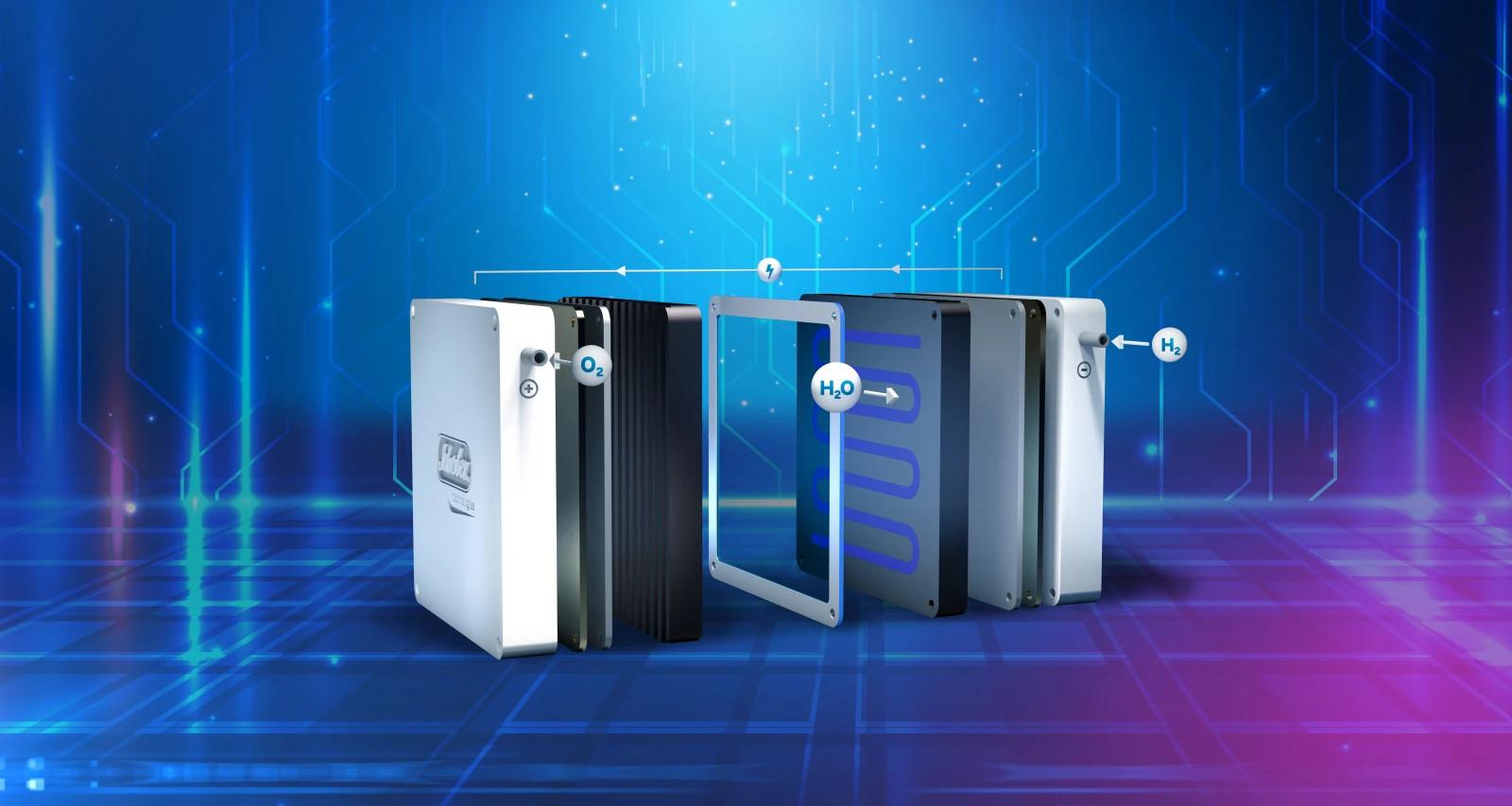
Fuel cell technology is widely regarded as a key building block of future energy and mobility systems. From automotive applications to stationary power generation, fuel cells promise high efficiency and low emissions – provided that scalable, reliable manufacturing processes can be established. One of the critical challenges lies in the precise and gentle processing of thin, sensitive functional materials such as membranes and bipolar plates. This is where rotary converting technologies are increasingly gaining attention.
Schobertechnologies GmbH, headquartered in Eberdingen, Germany, has been developing rotary tools, modules and specialised converting machines for more than 75 years. While traditionally rooted in the paper, film and foil converting industries, the company has gradually expanded its portfolio into high-tech application fields, including medical technology, electronics, automotive engineering – and fuel cell manufacturing.
Meeting extremely tight tolerances
In fuel cell systems, particularly in proton exchange membrane (PEM) technology, components such as bipolar plates and membrane electrode assemblies (MEAs) must meet extremely tight tolerances. The catalyst-coated membrane (CCM), a core element of the MEA, is especially demanding to process. It is thin, flexible and highly sensitive to mechanical stress as well as environmental influences such as temperature and humidity. Conventional processing methods often reach their limits when handling these materials at industrial scale.
Rotary web-fed converting offers a different approach. Instead of intermittent, stroke-based operations, the material is processed continuously, significantly reducing mechanical load and improving process stability. According to Schobertechnologies, rotary die-cutting and punching technologies have proven particularly effective when integrated into fuel cell assembly lines, allowing sensitive membranes to be processed with high precision and repeatability
The company provides both inline and offline rotary solutions for finishing bipolar plates and membranes. These include embossing tools with customised pattern designs for bipolar plates, rotary die-cutting systems optimised for delicate membranes, and punching tools capable of producing dense hole patterns using exchangeable punches and dies. In addition, Schobertechnologies offers combined tool concepts that integrate embossing and die-cutting functions into a single rotary unit, reducing process steps and footprint.
Rotary systems for material handling
Another important aspect in fuel cell manufacturing is material handling. Rotary systems allow the web to remain under controlled tension throughout the process, minimising deformation and damage. Cut-and-place modules can separate individual components from the web and place them accurately onto a moving carrier substrate, either at fixed or variable distances. This is particularly relevant for high-volume production scenarios where automation and cycle time are critical.
Beyond individual tools, Schobertechnologies also supplies modular rotary converters that combine calendering, embossing, punching and die-cutting functions in a single machine architecture. Such modularity allows manufacturers to adapt production lines to different fuel cell designs or future product generations without completely redesigning the process.
Growing relevance of these technologies
From a market perspective, the relevance of these technologies is set to grow. Global investment in hydrogen and fuel cell technologies continues to increase, driven by decarbonisation targets in transport and industry. As pilot projects transition into serial production, manufacturers are under pressure to scale up output while maintaining quality and cost efficiency. Continuous, web-based processes are seen as a key enabler for this transition.
To support development and industrialisation efforts, Schobertechnologies operates an R&D centre equipped with rotary test tools for embossing, punching and die-cutting patterns. This allows customers to evaluate process feasibility and optimise tool designs before moving into series production—an important factor in a market where materials and component architectures are still evolving rapidly.
As fuel cell technologies move closer to mass deployment, manufacturing expertise will become just as decisive as electrochemical performance. Rotary converting solutions offer a pathway to combine precision, scalability and gentle material handling—three requirements that are essential for turning fuel cell concepts into industrial reality.