

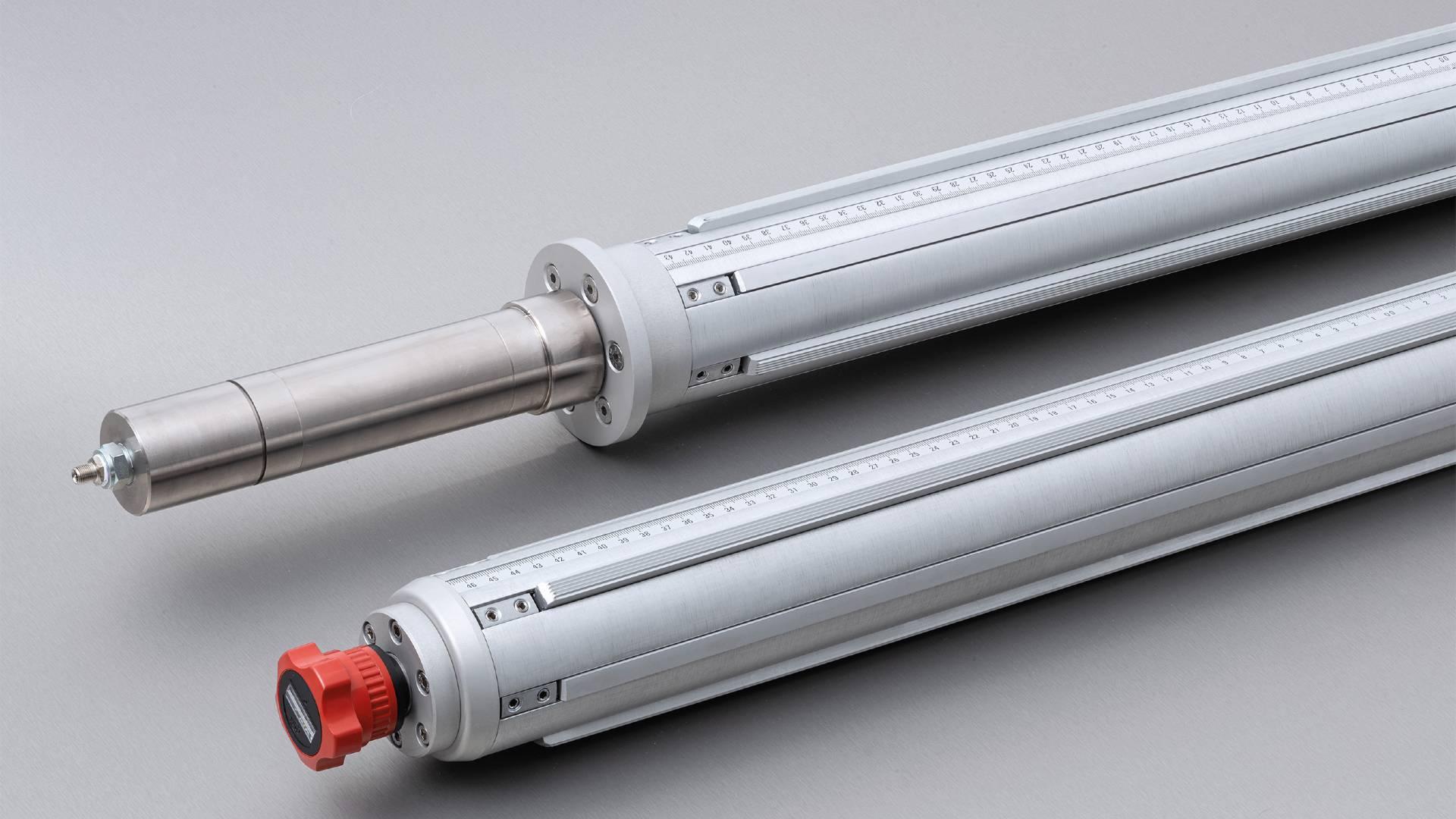
How a custom modification to a standard clamping shaft enables fine adjustment of the web position directly on the clamped roll, mechanically and with a readable setpoint.
A heavy material roll sits on the clamping shaft, is pneumatically clamped, and is positioned a few millimetres too far to the left. Even pre-positioning with a ruler is rarely accurate to the millimeter, and manual readjustment becomes a complicated matter due to the weight.
In food packaging machines, the exact axial position of the unwinding material web determines the result of the subsequent process. Print image, seal seam, and cut edge stand or fall by millimetres, and even slight offsets lead to waste at the beginning of every roll.
A machine manufacturer from the packaging industry approached IBD Wickeltechnik with exactly this task: the unwinding station of a machine in the food sector was to be designed so that the operator could reproducibly bring the web position to the setpoint after every roll change — without tools, without sensors, and without loosening the roll again.
Web guide systems: the obvious answer that doesn’t fit here
The usual standard solution would be an upstream web guide system. For this application, it is unsuitable for two reasons. Firstly, a continuously regulating sensor system is oversized for the actual task. Secondly, and this often carries more weight in the food sector, every additional sensor, cabling, and control electronics in the splash zone of the machine brings a design problem: food packaging systems are wet-cleaned daily. Anything that is not washdown-compatible costs design effort, expense, and approvals.
Shifting under tension, reading from the counter
The cantilevered clamping shaft of the PSW-F series with an aluminium profile and axial air supply via the bearing journal served as the basis. By default, the shaft body sits firmly on the bearing journals. For this application, the shaft was built as a special version with an axially displaceable shaft body that can still be moved even when the roll is already clamped. This is the decisive design point: the adjustment mechanism takes the load off the operator and turns the impossible manual shifting of a heavy roll into a rotary movement at the front end.
For this application, the front adjustment was equipped with a mechanical counter. The axial position of the clamped roll can be continuously adjusted over an adjustment path of 15 mm, and the counter displays it directly as a numerical value.
Mechanical, because the application demands it
The adjustment mechanism works purely mechanically, without sensors, without cabling, and without supply voltage. This is not just a question of cost. In food packaging machines that are wet-cleaned daily, everything that is not washdown-compatible has a hard time.
Control task or adjustment task?
The fundamental point lies in the distinction between control and adjustment tasks. A web guide system makes sense if the web position changes during the production run and must be continuously corrected. On an unwinder, however, the position is approached once per roll change and then remains stable. What is needed here is not control, but a repeatable adjustment in the clamped state.
How users help themselves without this option can be seen in every workshop. Pre-positioning with a ruler is never accurate to the millimetre, and the heavy clamped roll can no longer be moved by hand against a known deviation of a few millimetres. Those who do not want to accept the offset loosen the shaft, push it further, clamp it again, and repeat this until it fits. IBD’s clamping shaft with counter solves this differently. A web running 3 mm too far to the left is corrected exactly in the clamped state with three marks on the counter.
“A web guide system is overkill for many unwinding tasks and is often even the wrong tool from a design perspective in the food sector. Most operators do not need continuous control, but a way to reproducibly bring the clamped roll into position without loosening it again. The front adjustment is built exactly for this, and the counter turns the turning of the knob into a value on the scale,” says Dennis Upmann, Design at IBD Wickeltechnik
Practical benefits
The benefit lies on two levels. Firstly, there is no need for loosening and re-clamping, which would otherwise be necessary to bring a roll that has shifted too far back into alignment. Secondly, there is no tolerated start-up waste because the position is correct from the very first metre. With several roll changes per shift, both effects add up to noticeably less downtime and less waste.
Transferable to other converting processes
The principle can be transferred to practically any manually operated adjustment controller in the converting process. Wherever a position is approached once per roll change and then remains stable, a readable mechanical scale is superior to electronic control both in terms of design and economy. The prerequisite is that adjustment is possible at all while the roll is clamped. This is exactly what the shaft body under the counter achieves.