

Paperboard is for many brand owners, marketing departments and their print and converting partners: the dream material. It has great environmental credentials, and unlike many packaging materials, it is derived from inherently renewable and recyclable resources. A well- managed plantation of trees has the potential to produce an endless supply of paperboard. Once used, reprocessed and converted, it is possible for either a coated or uncoated material to go on to produce goods as diverse as shoe boxes, dry food packaging; the outer container of a cereal box or something more luxurious.
Value-added processes
Paperboard is available in a variety of grades and can be shaped into a conventional rectangular shape or into a number of configurations including pyramids and circles. Value-added processes, including printing, dramatically enhance its appearance. Surfaces can be embossed, de-bossed and depending upon the grade and type of material, the chosen surface can be hot stamped or made to accept holographic images and varnishes.
There are many substrates that can be used for luxury packaging, but for optimum billboard opportunities, paper and paperboard excel. Packaging can help to elevate the status of an item, whether it’s a high cost much hyped item that conveys a sense of prestige or defines a sense of worth or those reasonably priced items that may not be essentially grand but they constitute luxury in not being part of a regular shop: those scented candles; those gift-boxed chocolates or perfumery; or even an updated smartphone.
So much rides on colour. It is the one area where much can still go wrong. Despite the best intentions of the designer and marketers, sometimes a colour just does not sit right in the cold light of day. Even if the graphical content, logo and other value-added attractors seem a good fit, if a colour is wrong, if there is a tonal mismatch or colour is not reproduced effectively, then the product will fail to please and sell.
Inconsistencies may arise
While advancements in technology make it theoretically easier to control colour, variables and inconsistencies may arise. For instance, ink film thickness can impact the pigment/vehicle ratio, sometimes adversely affecting printed product appearance.
A deep red or yellow may look good when the designer presents the customer with a visual, either a printed sample or on screen, and it is easy to become enthused. Sometimes the results are not so pleasing when run on press. For example, if a high-gloss appearance is required, a slight absorption increase in the stock may have unintended consequences. Too high a concentration of pigment particles protruding through the surface varnish layer will make the printed colour look lighter and perhaps less glossy than desired. Opting to go for a slightly lighter colour will allow less pigment loading and will make for a thinner ink film. Doing so will permit a print operator to make ink colour adjustments as they go and over the course of the run without compromising too much on quality.
Interpreting colour and getting it right time after time and run after run can even today remain a challenge. Even the decision to simply change paper stock can become problematic. Paper brightness, surface quality and neutrality; deviation from colour cast all have an effect on how colours will appear when printed.
Regardless of the difficulties, the converter that prints must meet the demands of the customer and produce a quality product. Colour communication, proofing or as they are sometimes referred to as sample preparation systems, enable users of many descriptions, including ink manufacturers, to hit colour targets quickly and with minimal waste.
K Printing Proofer
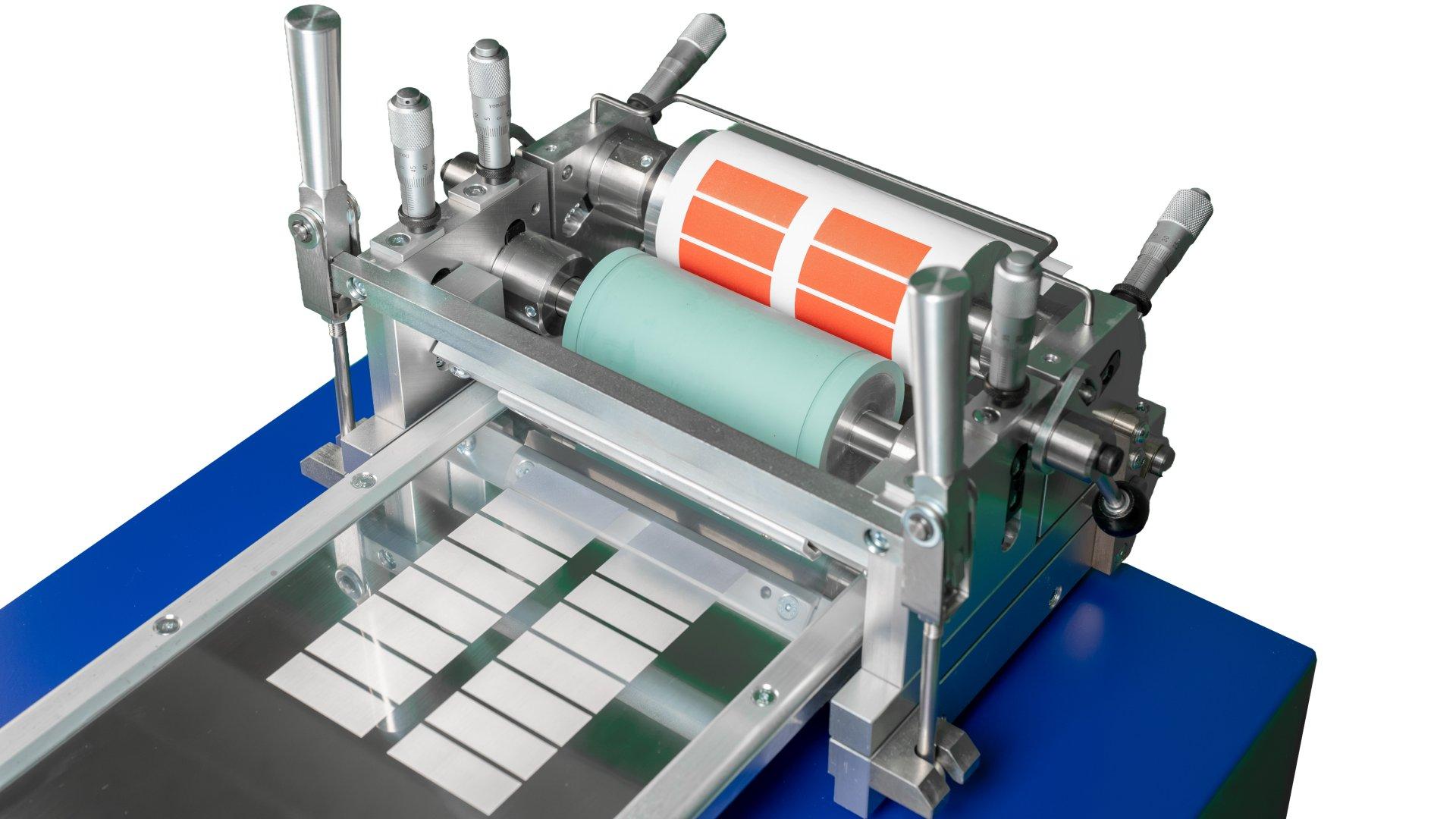
The K Printing Proofer is a compact benchtop colour communication device, which is able to accommodate any flexible material, which may be printed or laminated. The K Printing Proofer is equipped with electronically engraved printing plates and offers variable printing speeds of up to 40 metres per min. Both impression and doctoring settings are finely micrometre-controlled. The K Printing Proofer can proof using gravure, gravure-offset and flexographic inks. Two or more inks can be printed simultaneously for comparison purposes, and registration is included for overprinting.
Both wet and dry laminating samples can be obtained by using the gravure printing head in conjunction with RK Print Coat Instruments’ own K-Lam laminating accessories, which include a rubber-covered bed and wired K-Lam bars that are fitted in place of the doctor blade assembly to control coat weight.
Paperboard generally provides marketers and designers with one of the largest surface areas for the placement of colour and content. However, it can be all too easy to get carried away during the design stage. One must never lose sight of the fact that there is a great deal of difference between a design that looks good and one that prints well.
A good design is one that can be printed at speed and for which acceptable colour saturation can be obtained and then maintained throughout the entire tonal range. If processes such as flexography are involved, an optimised flexographic design would be one that allows for proper traps, colour balance and screening of final proof.
Written by Tom Kerchiss, RK Print Coat.