

Perfumery or fragrances and cosmetics have always had a certain cache, associated as they are with indulgence, self-image and luxury consumerism. Packaging and labelling for cosmetics and particularly fragrances must be of the highest order. A good deal of brand awareness is due to presentation. Some would say that perfumery and cosmetic goods are sold as much by the choice of font and by colour, design and by other embellishments. While that may be an overstatement, product appearance is part of the purchasing experience, materials such as printed carton encourage sales.
Carton and paperboard are favoured by brand owners, marketers, converters, and by consumers and just about everyone else. Carton/paperboard is considered to be a sustainable packaging medium and therefore has a more environmentally acceptable profile. While that statement generally holds true, some thought must be given to consumables and materials, inks and coatings, varnishes and any additional converting processes that may follow. Procedures such as product monitoring and quality control are advisable.
Paperboard advantages
Paperboard prints well and accepts a variety of decorative enhancements. Including varnishing, embossing, de-embossing, hot foil stamping, extrusion coating and lamination, etc. Carton is an ideal packaging medium for communicating glamour, exclusivity and aspirational or celebrity lifestyle, or other wish for requirements.
Properties that are high on the agenda when selecting carton include good compression strength, a smooth surface, rub and abrasion resistance and an ability to endure the rigours of cutting, creasing and folding. A flat and stable surface in both longitudinal and transverse directions, together with excellent absorption properties, facilitates print and conversion. Carton material extends creative and practical possibilities by enabling designers to provide a variety of distinctive shapes, including the conventional square or rectangular shape; cartons with curved panels; triangular shape, as well as lined or barrier-coated and other configurations.
Brand owners expect printed cartons and the labels that generally adorn the container within the carton outer pack to show off their products to the best advantage. Glass, often coloured and decoratively shaped, as well as the labelling, is subject to lavish and often intricate attention. Labels are applied to the primary container or are affixed to secondary packaging.
Advances in flexography, particularly in areas such as UV flexo, have enabled converters that print to provide effects that were once only possible using silkscreen processes, more efficiently and more cost-effectively.
UV flexo is often used, offering finer print resolution, high gloss levels and a resistance to rub and abrasion. UV flexo can also enable users to emboss, foil stamp and even slit inline for speed of delivery.
Colour consistency is critical
Whether used for primary or secondary packaging, colour consistency is critical and process variables must be brought under control. To ensure that all of the flexographic printing, coating and other requirements are met, there must be a way of determining quality and of resolving potential production problems as far as possible offline so that production isn’t held up and waste is kept to a minimum.
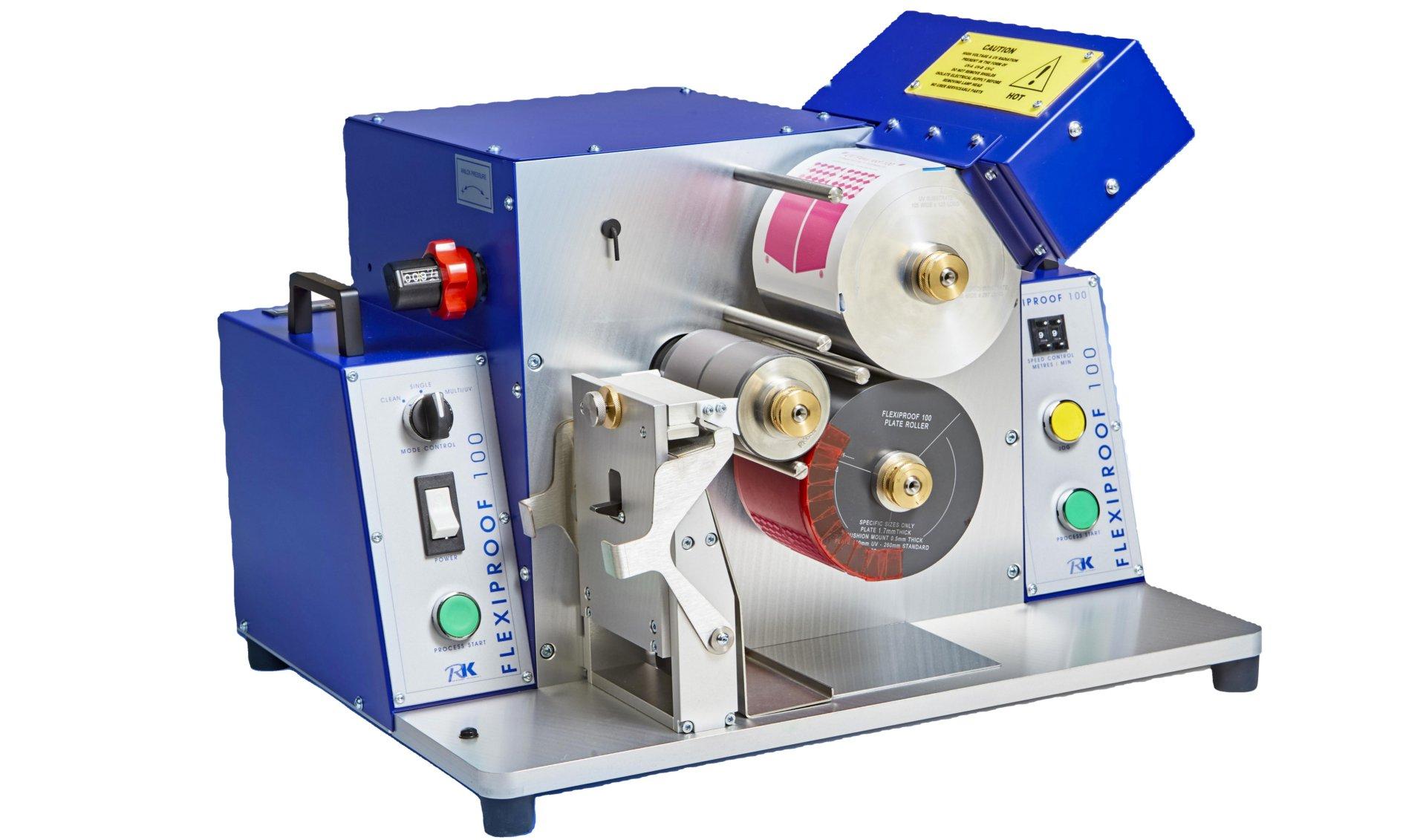
Colour communication devices such as the FlexiProof enable a wide range of customers, including substrate producers, ink and other consumable providers, as well as converters, to trial unfamiliar materials, adjust and match colour and determine printability issues, gloss, rub resistance, durability, etc.
The FlexiProof UV and FlexiProof LED UV are equipped with a miniaturised UV unit so that printing and curing are accomplished seamlessly: any blemishes, such as pin holes, are detected readily. This overcomes the problem associated with UV proofing using a conventional route for UV proofing: once a proof is made and then taken to a UV conveyor, chemical surface properties will have changed quite dramatically, and pinholes and other blemishes will not show up.
In product sectors such as printing and converting for perfumery goods, the room for error, inconsistency of colour and other quality-dependent processing elements is very small. Colour communication devices such as the FlexiProof for flexographic processes or the GP100 for gravure help to ensure both product and commercial viability. Another option is the VCML pilot print, coat and laminating system. This too can be supplied with UV flexo or gravure and with selectable coating applicator technology such as slot die, knife-over-roll, direct, offset and reverse gravure, etc.
Written by Tom Kerchiss, Chairman of RK Print Coat Instruments Ltd.