

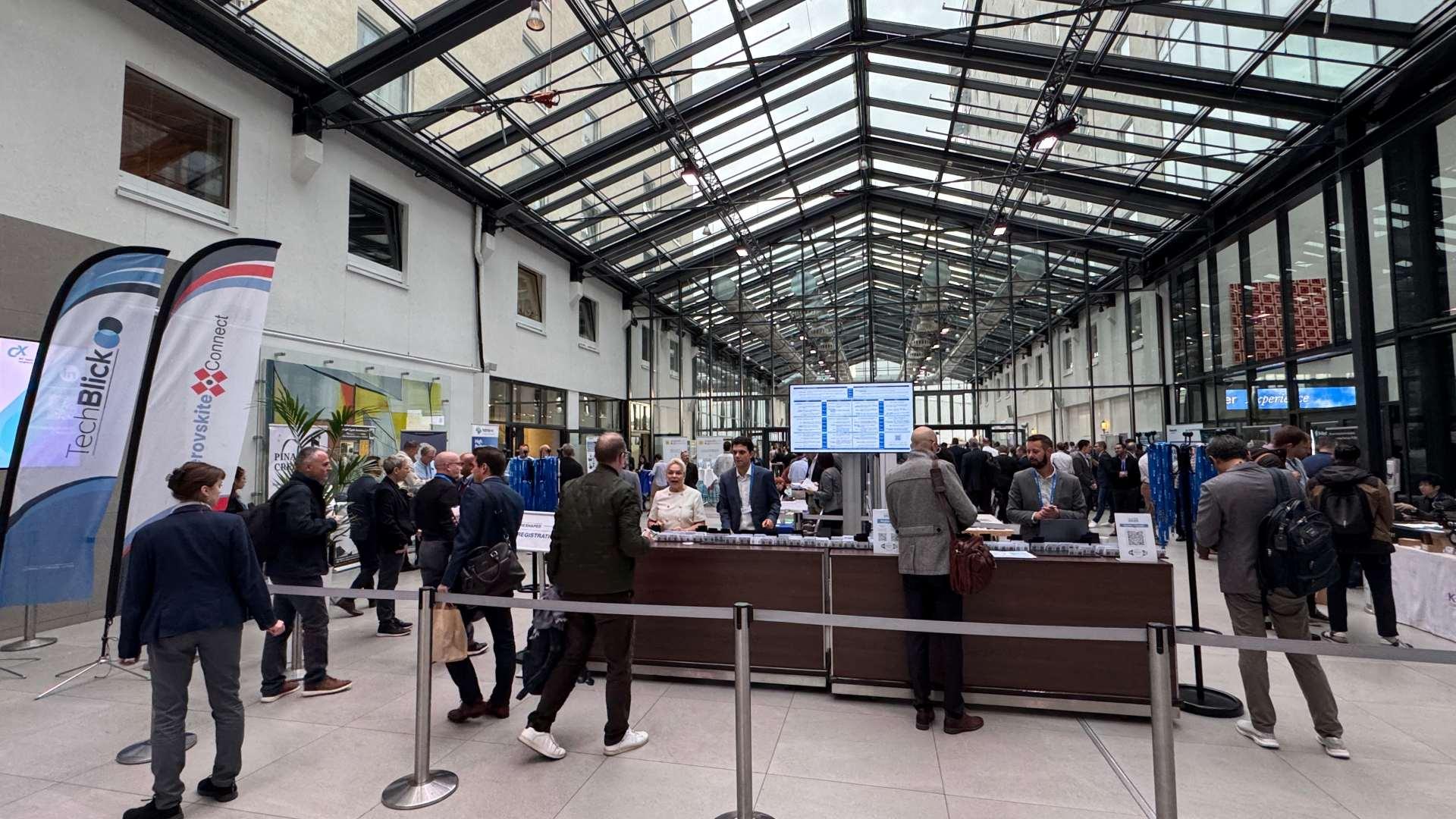
From silver-coated copper and room-temperature copper processing to biosensor inks, graphene, stretchable conductors and advanced substrates: TechBlick Berlin (21 and 22 October, The Estrel Berlin) will put materials innovation at the heart of its 2026 programme.
When discussing the future of printed and flexible electronics, it is tempting to focus on the finished product: a smart textile, a flexible sensor, a wearable device or a new generation of hybrid electronics. But before any of these applications can become reality, there is a more fundamental question: what are they actually made of?
At TechBlick’s The Future of Electronics RESHAPED, taking place on 21 and 22 October 2026 at the Estrel Congress Centre in Berlin, materials, inks, pastes, substrates and interfaces will take centre stage. The conference and exhibition will bring together developments spanning additive, hybrid, 3D, sustainable, wearable, soft and textile electronics. The event is co-located with Electronic Textiles RESHAPED, Sustainable Electronics RESHAPED and Perovskite Connect, giving visitors access to four events with a single pass.
Conductive inks: the silver question
One of the persistent questions in printed electronics is how to maintain conductivity and reliability while reducing material costs. With silver prices and their volatility at elevated levels, alternatives to conventional silver-based conductors are attracting growing attention. At TechBlick Berlin, several presentations will examine this challenge.
Daniel Lacorte of Ames Goldsmith will present advances in silver-coated copper materials for high-performance printed electronics. Core-shell powders and flakes combine copper with a silver coating and are being investigated as a more cost-effective alternative to pure silver. The approach also addresses challenges associated with copper, including oxidation and ionic copper leaching, as well as their potential impact on material stability and pot life.
A different route is being pursued by the University of Southampton. Jessica Pereira will present a patented copper platform for producing highly conductive, air-stable copper films at room temperature – without thermal or photonic sintering. Based on biopolymer-stabilised particles and mechanical compression, the technology has achieved reported electrical properties of 2.05–2.33 × 10⁻⁸ Ωm.
Meanwhile, Jacqueline Putz of Henkel will provide a masterclass on electrically conductive inks, covering formulation, printing processes and application requirements. Ryan Banfield of Heraeus Electronics will look at silver inks for stretchable electronics and reliable performance under repeated deformation.
Beyond conventional conductors
Conductivity is only one part of the materials equation. Functional inks are increasingly being developed for specific sensing, heating and other applications – often with sustainability requirements built into the formulation.
Phil Nicholas of Sun Chemical will address the balancing act involved in developing electrochemical biosensor inks, focusing on ink design, processing and end-use performance for screen-printed electrodes used in applications ranging from glucose test strips to next-generation diagnostics.
BLACKLEAF will present water-based graphene inks designed for high-performance thermal heating elements. The approach aims to combine graphene’s electrical and thermal properties with a formulation that avoids solvent-heavy chemistry.
ACI Materials will bring its functional material expertise to Berlin. Its recent work has focused on printable conductors for flexible hybrid electronics, wearables and e-textiles. Its Alchemy semi-sintering conductor series is designed to combine the processability of polymer thick films with the electrical performance of sintered inks, while addressing reliability issues such as galvanic corrosion under damp heat.
Ercon will present conductive ink technologies for printed sensing, including conductive polymer thick-film inks used in blood glucose test strips and body electrodes.
The materials underneath the ink
There is a tendency to regard the substrate as the supporting actor in printed electronics. In reality, it can be just as important as the functional material printed on top.
Jarne Machiels of Avery Dennison will explore ink and adhesive compatibility in flexible hybrid electronics. A validation programme examined different pressure-sensitive adhesive technologies in combination with functional inks. One key conclusion is that there is no single “holy grail” adhesive: compatibility depends on multiple variables related to both the ink chemistry and adhesive matrix.
Covestro will present tailored TPU films for flexible and stretchable printing. Thermoplastic polyurethane can be modified for specific application requirements, making it an interesting substrate option for lightweight and flexible printed sensor systems.
Kimoto will focus on carrier and protection films for handling sensitive surfaces and flexible substrates as printed electronics moves towards industrial manufacturing and roll-to-roll processes.
Policrom Screens will discuss TPU substrate technologies for printed, hybrid, stretchable and wearable electronics, including its ELECROM STRETCH system.
When electronics have to stretch – and survive the washing machine
The requirements become even more demanding when electronics are integrated into textiles. Conductive materials have to cope not only with bending, but potentially with stretching, sweat, temperature changes and repeated washing.
The Leibniz Institute for New Materials will present screen-printable hybrid conductive inks for stretchable temperature sensing and heating. The technology combines metal and carbon fillers in a stretchable matrix. Testing between 20 and 120 °C and under repeated thermal and mechanical cycling has demonstrated a linear resistance response suitable for temperature sensing or active temperature control.
Nagase ChemteX will address stretchable, wearable and washable inks – materials that need to maintain performance despite repeated mechanical and environmental stress.
And then there is liquid metal. Lukas Werft of Fraunhofer IZM will lead a masterclass on gallium-based liquid metal inks for stretchable electronics, examining viscosity, wetting, line formation and electrical continuity.
PRO Flextronics will be there
For PRO Flextronics, TechBlick Berlin is a natural meeting point with the industry. We will be on site as a media partner, reporting directly from the event and producing video clips with exhibitors and speakers for our LinkedIn channels.
With leading ink, paste and substrate suppliers joining equipment manufacturers and print houses, TechBlick Berlin offers an opportunity to look at the printed electronics value chain from several angles – from the formulation of a conductive ink right through to the finished application.