

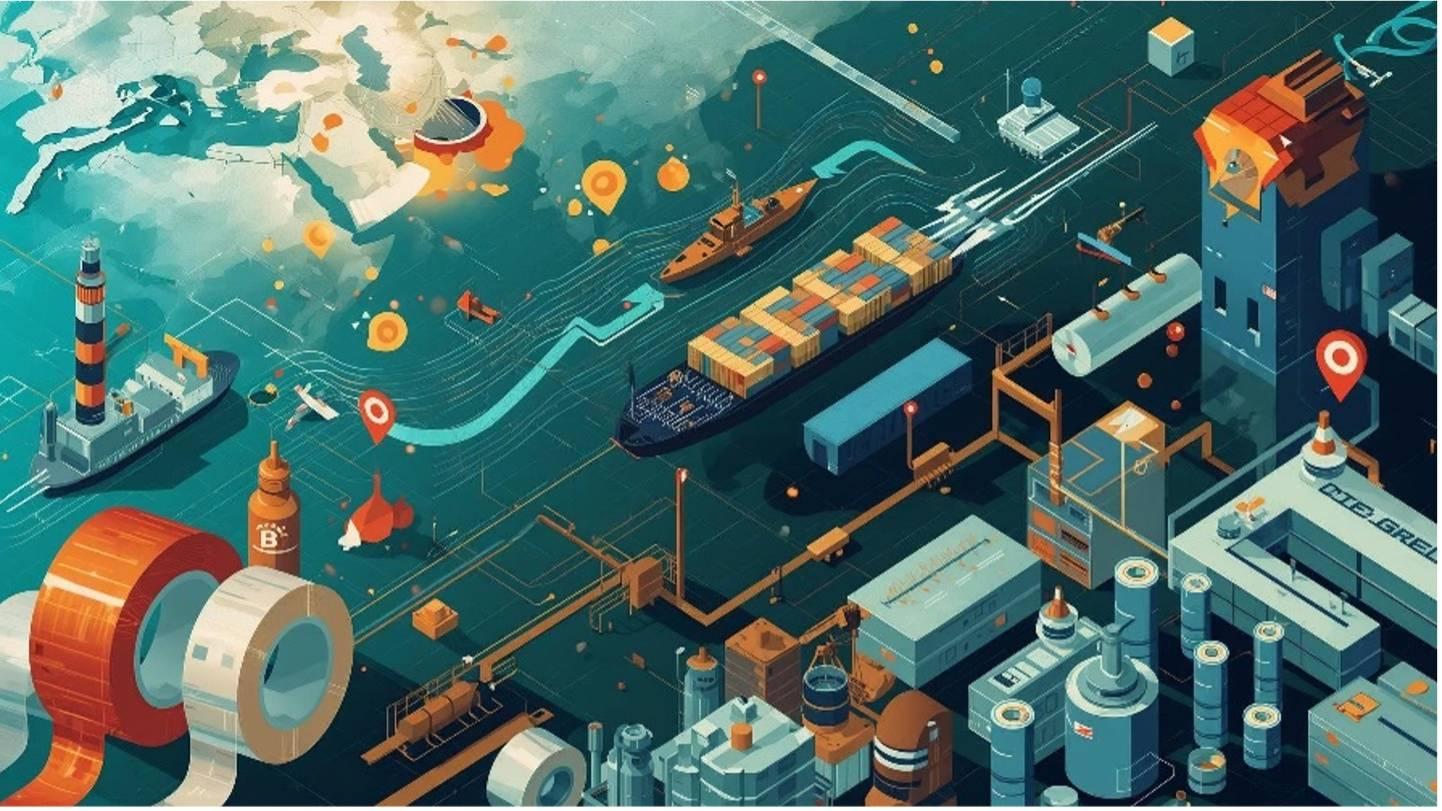
For Europe’s adhesive tape industry, the conflict involving the U.S., Israel and Iran is no longer a distant geopolitical crisis. It is feeding into the economics of tape production, affecting energy, petrochemical inputs, freight, lead times, pricing and customer demand across the value chain.
The diplomatic picture remains fluid, but that has not restored normal commercial conditions. More than 20 vessels passed through the Strait of Hormuz on Saturday, the highest daily number since 1 March, yet by Monday, traffic was again close to a standstill, with just three crossings recorded in 12 hours after the U.S. seized an Iranian cargo ship and Iran fired warning shots at vessels, including a CMA CGM ship. Iran said on Monday it was positively reviewing whether to attend new Pakistan-mediated talks, but had not decided, and blockade issues remain central to whether negotiations move forward.
The Strait is far away. The shock is not.
For European tape businesses, the first transmission channel remains energy and petrochemicals. The IEA’s April Oil Market Report said restrictions on tanker movements through Hormuz contributed to the largest supply disruption in history, and the agency has also identified resuming flows through the strait as the single most important variable in easing pressure on energy supplies, prices and the global economy.
That matters because the adhesive tape value chain remains deeply petrochemical. The sector’s raw-material base includes petroleum, petroleum by-products, natural rubber, acrylic resins, silicone rubber, dispersions, polymers, solvents and other chemicals. Adhesive tapes have historically relied on petrochemical derivatives such as synthetic rubbers, acrylics and silicone-based adhesives. In other words, when feedstock markets are disrupted, the impact does not stop at refineries or crackers; it runs directly into adhesive systems, films, liners and converting economics.
Europe is also entering this shock from a weakened upstream position. Reuters reported on 13 April that European chemical companies were expected to report weaker first-quarter results because the war had disrupted fuel and feedstock markets and driven up prices for an industry already burdened by subdued demand, high energy costs and supply-chain strain. On 15 April, Reuters also reported that the European Commission warned member states that a prolonged conflict could trigger a lasting energy shock, complicate gas storage ahead of winter and create ripple effects across industrial supply chains.
The latest reporting suggests the issue is no longer just whether energy prices spike for a few weeks, but whether access to feedstocks and shipping lanes can return to something recognisably normal on a commercially useful timetable. Reuters’ 20 April analysis argued that even if the guns fall silent, flows through Hormuz may take months, and possibly years, to recover fully because shipping, insurance, tanker logistics and damaged infrastructure all need to normalise.
From feedstock pain to factory-floor pressure
The petrochemical angle has become more direct, not less. Reuters reported on 16 April that Iran had halted all petrochemical exports until further notice after Israeli strikes disrupted production at key hubs in Asaluyeh and Mahshahr. The stated aim was to preserve domestic supply and prevent raw-material shortages, but for Europe’s tape chain, the practical point is straightforward: A conflict that had already driven prices higher is also constraining availability more explicitly.
That risk remains more than theoretical. Reuters reported on 15 April that Japanese manufacturers dependent on naphtha-based inputs were already flagging supply problems, with disruption extending to materials such as adhesives and thinner. Three days later, Reuters reported that Japan’s trade minister said these bottlenecks could likely be cleared within days, which is a useful corrective: The stress is real, but some parts of the chain may still prove more adaptable than the worst-case reading implies.
Shipping conditions reinforce that pressure. On 17 April, Reuters reported that Iran said ships could pass through Hormuz only in co-ordination with the Revolutionary Guards and on routes Iran deemed safe, while U.S. Navy guidance said the mine threat in the Traffic Separation Scheme was still not fully understood. BIMCO said shipping companies should consider avoiding the area. That is materially more restrictive than an ordinary reopening, and it goes directly to the cost and predictability of moving chemicals, films, liners, machine parts and finished goods.
The weekend’s stop-start traffic does not really soften that conclusion. Some tankers did get through on Friday and Saturday, but Reuters reported that hundreds of ships remained stranded, some ships turned back, and by Monday traffic had again fallen to a fraction of normal levels. War-risk insurance rates, which had started to ease when Iran briefly said the strait was open, rose again to around 3% of ship value after the latest escalation.
For day-to-day tape operations, the likely effect therefore remains cumulative rather than dramatic. The industry may not see immediate, widespread shutdowns. More often, the strain is likely to appear through shorter quotation validity, more supplier repricing, tighter raw-material allocation, more cautious stockholding, harder conversations around surcharges and more management time spent on sourcing and contingency work. That remains an inference rather than a direct tape-sector survey, but the last few days have strengthened rather than weakened the logic behind it.
This is no longer background noise
The strategic lesson is therefore broader than procurement. This is no longer only a question of whether oil spikes for a few weeks. It is a question of how European manufacturers compete when energy, molecules and logistics all become less predictable at the same time, and when access to Hormuz itself is becoming part of the diplomatic bargaining. Reuters reported on 20 April that Gulf officials fear current talks may end up cementing Iran’s leverage over Hormuz rather than resolving the wider security problem, which underlines how central the chokepoint has become to the region’s new political economy.
There is now also a more explicit European policy response. Reuters reported on 20 April that E.U. ambassadors had politically agreed to widen the criteria of the bloc’s Iran sanctions regime so that it can target those responsible for obstructing freedom of navigation in the Strait of Hormuz. That is a notable development for Afera Members because it confirms that Hormuz disruption is no longer only a market and shipping problem; it is now moving directly into Brussels policymaking as well.
At the same time, the latest macro signal is not entirely one-directional. Reuters reported on 20 April that ECB President Christine Lagarde said the war’s economic effects had not yet reached the bank’s adverse scenario and that there was still limited evidence of broad supply-chain disruption or second-round inflation effects in the euro zone, even though local tensions were visible and jet fuel prices had roughly doubled since the conflict began. That is a useful nuance. It suggests the most immediate risk for the tape value chain remains commercial unpredictability and sector-specific strain, rather than an already fully generalised European crisis.
For Afera Members, the conflict still touches top-level strategic positioning and everyday functioning alike: supply security, price discipline, customer reassurance, inventory policy, sourcing flexibility and competitiveness. The key issue is not whether the Strait of Hormuz is geographically close to Europe. It is whether a tape value chain built on petrochemicals, energy-intensive chemistry and globally connected logistics can operate normally while one of the world’s critical energy chokepoints remains politically contested, commercially unreliable and only intermittently passable. As of 20 April, the answer is still no.
Sources
- Reuters, “Some tankers cross Strait of Hormuz before shots fired, ship-tracking data shows,” April 18, 2026
- Reuters, “US seizes Iranian cargo ship, Tehran vows to retaliate,” April 19, 2026
- Reuters, “Fate of Iran peace talks uncertain as deadline approaches for end of ceasefire,” April 20, 2026
- Reuters, “Hormuz shipping again near standstill after shots and seizure,” April 20, 2026
- Reuters, “E.U. to widen Iran sanctions to those who block Hormuz,” April 20, 2026
- Reuters, “Gulf worries US-Iran talks may cement Tehran’s ‘golden’ grip on Hormuz,” April 20, 2026
- International Energy Agency, “Oil Market Report – April 2026,” April 14, 2026
- International Energy Agency, “The Middle East and Global Energy Markets,” accessed April 20, 2026
- Reuters, “European chemical firms, hit hard by Iran war, to report falling Q1 earnings,” April 13, 2026
- Reuters, “EU warns of prolonged energy shock, forced cuts if Iran war continues,” April 15, 2026
- Reuters, “Iran halts petrochemical exports until further notice,” April 16, 2026
- Reuters, “Japan naphtha-dependent firms flag supply issues despite government assurances,” April 15, 2026
- Reuters, “Japan says energy-related supply chain bottlenecks can be cleared within days,” April 17, 2026
- Reuters, “Ships crossing Hormuz need OK from IRGC, unfreezing funds part of deal, Iran official says,” April 17, 2026
- Reuters, “Opening Hormuz is the easy part. Restoring oil flows isn’t,” April 20, 2026
- Reuters, “ECB needs more data before firm policy conclusions, Lagarde says,” April 20, 2026.
For more information, visit www.afera.com.