

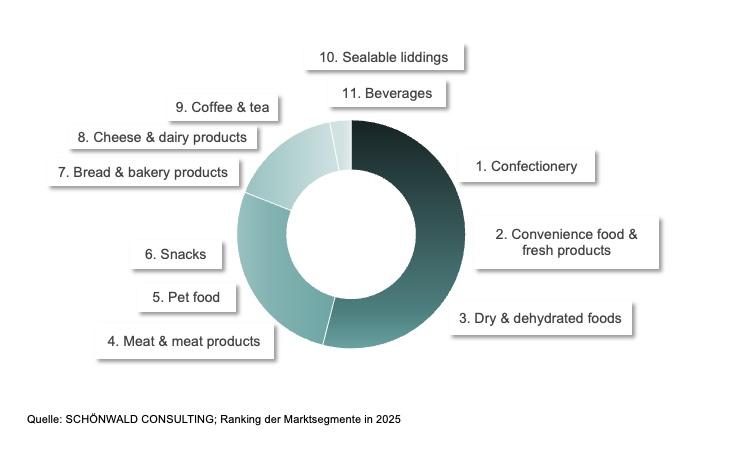
The consumption of flexible food packaging in Europe has continued to rise in recent years, reaching over 4.2 million tonnes in 2025. More than half of this was accounted for by confectionery, convenience/fresh products and dry foods. This is the conclusion reached by the latest study by SCHÖNWALD CONSULTING, “Flexible Food Packaging in Europe”, published in April 2026. It assesses consumption in 2025 across 11 market segments and 7 film composites.
The average annual growth rate up to 2030 provides insight into the future development of the market segments.
A variety of substrate materials
Flexible packaging utilises a wide variety of substrate materials, including plastic films, paper and aluminium foil, which are used either individually or in combination with one another. In this study, the current film laminates for flexible packaging are categorised into PET-, PA-, OPP-, PP- and PE-based films, paper-based flexible materials and flexible aluminium foils.
As has been the case for the past four years, OPP-based films account for the largest share of film composites. Consumption of paper-based solutions has continued to rise over the same period and now ranks second behind OPP-based films. Both film composites are used in the top three market segments and together account for more than half of all film composites in use.
Another key focus of the study is the European approach to sustainable packaging. Central to this is a detailed explanation of the Packaging and Packaging Waste Regulation (PPWR), including the relevant articles and the associated delegated and implementing acts. It also addresses the Guidance on the Packaging and Packaging Waste Regulation, published by the European Commission on 30 March 2026. A timeline provides information on the key regulatory measures, transition periods and deadlines arising from the EU Regulation.
Multi-material composites still at over 40%
Another section of the market study contains up-to-date information on single-material plastics, fibre-based solutions, bio-based plastics and recycled materials. Despite the increased use of single-material solutions, the share of multi-material composites in the flexible food packaging sector still stood at just over 40 per cent in 2025.
88 tables and graphs illustrate the findings of the 140-page study, which has been published in English.